 TFS Gulf



- Hi, I am Madhukar Hiregange, Founder of the 700+ member firm H N A & Co., and Council Member at ICAI.
- India has 100,000 CA firms…But most will never cross ₹10 crore in revenue. While the Big 4 quietly walk away with ₹10,000 crore mandates.
- Is the system designed to keep Indian CA firms small?
Why are CA firms in India struggling?
Survival mindset
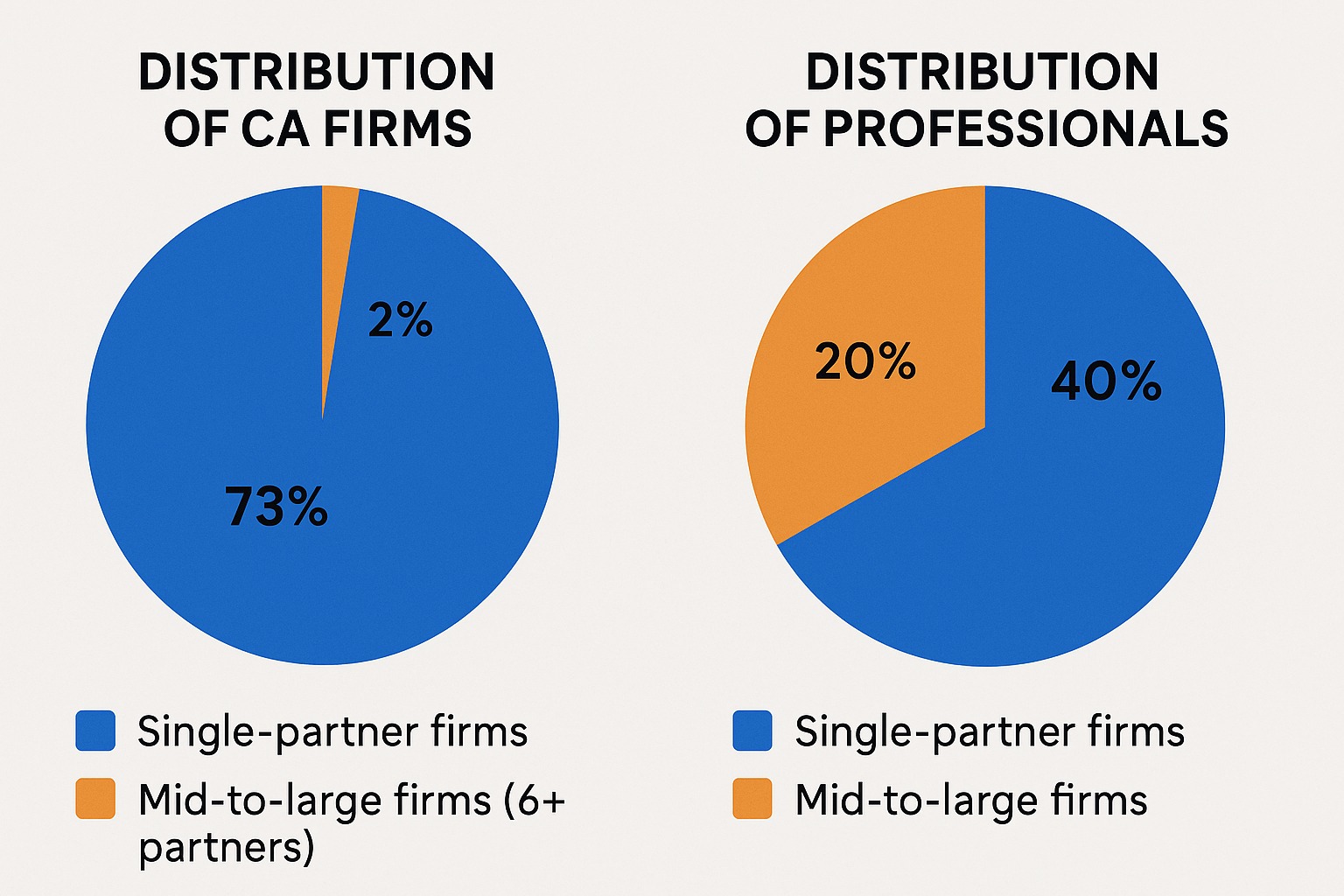
As of October 2025, India has over 100k CA Firms. Out of which 72,696 CA Firms are proprietorship firms.
I would say almost 90% are led by first-generation entrepreneurs, who typically come from economically challenged or middle-class backgrounds.
They prefer protected, predictable income, which usually comes from assignments like bank audits or cooperative audits.
They might be safe, but they will not help you scale. And that’s the mindset holding them back from scaling.
The “Satisfaction” Trap
Many think, “I have a car, two houses. I am ready to retire.” This tendency to slow down too early prevents us from using experience to scale further.
Over the past four years, I also stepped away from active consulting work.
(Guilty) Sometimes I can’t help but wonder how much more I might have achieved if I hadn’t.
Diversity gap: “No Non-CAs” rule
Today, client problems cut across tax, tech, data, law, strategy, operations, risk, and digital transformation.
Having a diverse set of talent/partners is no longer optional.
But ironically, the very structure of our profession doesn’t fully encourage it.
Yes, technically, firms can hire non-CAs as employees, but they are not welcome when it comes to Partnership, ownership, leadership, or decision-making power.
For example:
- I can’t make a brilliant engineer a partner
- I can’t give a tech-whiz equity
By barring non-CAs from leadership and ownership, we are essentially cutting off the very limbs we need to climb higher.
Not keeping up with the new trends
There is a massive disruption happening in all industries.
Business models that looked solid yesterday are collapsing overnight.
We’re seeing it happen to our own clients.
- Valuations dropping
- Margins shrinking
- Legacy businesses are struggling to survive
- Startups outpacing decades-old companies with half the team and ten times the tech
And yet, many firms in our profession are still operating as if “nothing” has changed.
The next issue is more structural
We simply don’t follow the best practices and standards that Big firms follow:
- Global professional standards
- Structured methodologies
- Strong documentation
- Consistent quality frameworks
And naturally, clients trust them with bigger assignments.
Good news: For the first time, ICAI has started a dedicated group on consulting standards, and I’m serving as the convener.
But let’s not pretend this is a breakthrough….Had ICAI acted 10 years ago, Indian firms would already be playing in the ₹1,000–10,000 crore league.
Also read: Dear CA Firms, 950+ listed companies to change Auditors….Well, Big 6 wins
But the elephant in the room…
Big 4’s influence
The Big 4 today have an almost unbreakable stranglehold on government contracts.
Most large government tenders often come with almost unattainable criteria:
- Have a minimum revenue of ₹500 crore. The government is now trying to help by breaking down large tenders into smaller bits. But many Indian firms still won’t qualify; we must move to an Alliance Model!
- Massive teams
- Pan-India presence
- Deep tech infrastructure
The Poaching Cycle: They acquire you as you grow or poach your best talent, so you can’t grow.
Unfair Systems: They build relationships by helping bureaucrats’ families with global placements. Audit work is often acquired on “influence,” not merit. ICAI has tried to bring transparency, but it hasn’t worked.
The ICAI dilemma
I say this as an ICAI Council Member ‘ICAI is a bureaucratic bottleneck. It’s obsessed with control (forms, branding, events, etc.).’
Another question I get asked often…Is the ICAI council unethically influenced by the Big 4? It is unfortunate, but true.
The Big 4 operate outside the strict purview of the ICAI, whereas domestic firms are bound by all regulations. This is a primary reason why Small and Medium-sized Practitioners (SMPs) aren’t growing.
Also read: Compliance services 400% growth: Most in-demand service line at Bengaluru CA Firm
So what now? What CA Firms should do?
The business environment has changed. And if we don’t change with it, we risk becoming irrelevant.
Here’s a personal example:
When I started, compliance work made up almost 90% of what we did. Today, it’s barely 10–15%. Why? The attest function is becoming less and less lucrative and more and more risky.
Honestly, unless you have no other choice, I don’t think firms should continue to rely heavily on this area anymore.
So here’s my controversial advice….
Give up your COP
The Certificate of Practice (COP), something most CAs cherish like a badge of honour, is actually holding them back.
Why? Because the COP:
- Prevents you from bringing non-CAs as partners.
- Blocks private equity /VC investment.
- Caps your ability to scale aggressively.
Meanwhile, the Big 4 don’t have this problem; they can innovate, invest, and scale without regulatory fetters.
To make your clients happy, you need to give them ideas, not just a signature!
If you still want to hold onto your ICAI registration and COP…Bifurcate your practice into two different legal entities:
- Attest and Compliance: A traditional partnership firm under ICAI
- Consulting, Outsourcing, and Advisory: A private limited company
In a private limited structure, there are no “fetters.”
You have no government or ICAI restrictions on how you brand, how you raise capital, or who you take as partners.
Collaborate & later merge
Another way to scale is through collaborations, which I call the dating phase.
The idea is simple:
- Work together on complex assignments.
- Refer to each other.
- Pay each other fairly for services.
For example, if I focus on GST services, I should collaborate with firms that have expertise in:
- International tax
- Foreign Exchange Management Act (FEMA)
- Intellectual property
- Real Estate (Regulation and Development) Act, 2016 (RERA)
This is where alliance structures like AOPs (Association of Persons) can be beneficial.
Here’s my advice: partner only with firms that have 500–1,000 professionals and ₹100–500 crore in turnover.
Why? Because scale wins mandates, or else big-ticket assignments, that may be untouchable for smaller firms.
Once trust is built, move to a formal merger (Consider a firm that already has some global presence)
Create Alliances with foreign firms
Indian CAs are incredibly sharp.
Technically strong.
Great problem solvers.
But sometimes we fall short on process, planning, and consistency.
That’s where foreign firms can help us by bringing in discipline, structure and most importantly, the infrastructure.
Stop distributing all profits to Partners
Indian firms often distribute all profits. And without capital, you can’t scale.
- No investment in technology
- No hiring strong talent
- No expansion
Tap into “Billion-Dollar” niche services
We are sitting on goldmines that we aren’t tapping because we haven’t upskilled.
Move away from routine “low-level” tasks that AI will soon eliminate. Focus on high-value domain knowledge.
- AI Ethics & Certification
- GCC Consulting: We can build wings of 100+ professionals specifically to service Global Capability Centres.
- Digital Transformation: Transform your own firm first, then sell that system to your 10,000+ clients.
- Virtual CFO & Strategic Outsourcing:
Also read: Building a CA Firm in a tier 2 city in India and merging with Singhi & Co
PMO on India’s Big 4
Prime Minister Modi knows critical information shouldn’t sit in Western-headquartered firms…And he wants a “Made in India” Big 4.
The Government’s initiative is fantastic, but they are not biting the bullet.
They are still influenced by the Big 4.
Intent isn’t enough; we need:
Company Law Reform
Allow CA firms to become scalable corporate structures. We need large-scale reforms, especially in the finance and consulting space. Small adjustments here and there won’t help.
The “China Model”
Force the Big 4 to be transparent.
In China, they must have local partners and disclose quarterly earnings. Why don’t we do the same?
Space, not control
In the 90s, the government gave IT firms strong policy support.
It gave the sector tax breaks, SEZ benefits, and export incentives, and, most importantly, stayed out of the way.
That’s how TCS, Infosys, and Wipro became global giants.
Reform the tendering process
Today, many tenders indirectly favour only the largest players. Smaller but capable Indian firms don’t even get a fair chance.
We need:
- Permissive system
- Merit-based system
- Democratic, merit-driven selection process
Wrapping up…
This is why I say if you want to build a ₹100-1000 crore firm in the next 5 years:
- Get out of the ICAI’s control
- Give up your COP if you have to
- Raise Capital
If we don’t change the rules of the game ourselves… We will remain stuck in the ₹10–20 crore bracket while the global firms walk away with the ₹10,000 crore mandates!
FAQs:
Can private equity really help a CA firm grow?
A: Yes. With private capital, you can invest in technology, hire top talent, and build scalable systems. Most CA firms are asset-rich in expertise but capital-poor. PE changes the game. But you cannot raise it while bound by COP restrictions.
What kinds of services should CA firms focus on beyond compliance?
A: The future is in value creation, not filings:
- Consulting & advisory
- Virtual CFO services
- M&A restructuring & due diligence
- Digital transformation & tech integration
- AI ethics & certification
- GCC and global outsourcing
Is this advice only for large firms?
A: No. Even mid-sized firms can adopt this approach. The key is a mindset shift, alliances, and a willingness to innovate. Scale isn’t just about size; it’s about strategic positioning and revenue mix.


Very nice sir future proof strategies to move from satisfaction mindset to great enterprenual mindset solving challenging business problems in the age of artificial intelligence.
Very very harsh Truth facts and very very nice and perfact article.
The article is an eye opener for CA or CS practising professionals. A multi-professional partnership (MDP) between Chartered Accountants (CA) and Company Secretaries (CS) by way of LLP will also help to grow the profession. This is pending with the Department for approval to my knowledge.. I am Practising Company Secretary in Bangalore and Founder Director of Conscientia Consultancy Pvt Ltd. The model of consulting through Pvt Ltd has given us benefits.
Madhukar: a little late in the day. CAs them selves are to be blamed for the unsatisfactory situation. And all these details coming from you, a very successful CA( as I know you well and have in the past attended good number of seminars conducted by you and your firm), is a sorry state of affairs.
Being a council member, you are in a position to set right many ills and shortcomings. Why aren’t you doing this. Just writing will not help.
Need any help from me, I can do.
Good luck.
ICAI introduces cources takes money and council members spend them happily. They are not doing anything for small firms. Yes COP is a locked chain on practicing CAs.
A brilliant analysis and presentation of the ails of the present CAs with correct suggestions to evolve into Big 4 like companies from India
Very bad idea sir, nothing is being done since you become Central council member and at last you are suggesting to giveup. In fact what we lack is unity. If CAs are united we can change but it never happens in India.
After going through one of the toughest exam and get CA degree with COP, then giving up. Now time has come ICAI should rethink. Else we will loose the talent and they will prefer to get specialisation through other education and traing system.
The problem diagnosis in the article is largely accurate, especially the point that small CA firms constitute the bulk of the profession.
However, many of the proposed solutions — PE funding, non-CA equity, high-end advisory pivots, large firm collaborations, or structural corporatisation — are not practical for small and sole-proprietor firms.
Most such firms lack surplus capital, access to networks, specialised manpower and risk appetite. They are still dependent on compliance work for survival, not because of lack of vision but because of ground realities.
Without scalable, step-by-step solutions tailored to small firms, these recommendations remain relevant only to a limited section of mid- and large-size practices.
Power driven futuristic Article on societal national level game changer
AOP: this is where we have to team up to play the G
ame
Collaborate & later merge
Another way to scale is through collaborations, which I call the dating phase.
The idea is simple:
Work together on complex assignments.
Refer to each other.
Pay each other fairly for services
Consider me I am not there to learn
Sir Each Line you have stated is 100% True. Above just one of our friend Anonymous has stated the facts also about the present scenario with mud size firms. Many Proprietorship firms are on the blink of dying stage and on Bed to reach its finality. Maximum 3 years. In this , being a CA Proprietorship firm, many of us under the dilemma how to proceed further. Being a family person and having finance responsibilities on shoulder , how to catch the modern train of Big Partnership Firm. Many of us are ready to move with the present earnings guarantee to the global service but the way was not clear . It is requested to you to please enlighten us the Indian Big B or Becoming Big B Firms names, contact details so that , many of us will approach them for further discussions. This will create Indian Big 100 for Global Work. In my opinion , if minimum amount was guarenteed to the talent , nobody can stop Bhartiya CA to Put His Name On The Globe in Next 3 to 5 years. Awaiting your reply. Thank you. CA N R Kabra Pune Maharashtra
Our profession structure clearly reflect structure of Indian economy. Is structure of Indian economy is fair and equitable? If not, is this solution workable?
Dear Sir,
Your are absolutely right. But people like you should fight and not give up. You have support of all.