 TFS Gulf




- Hi, I’m Andrew Simoes, Practice Head – GCC, Shared Services & Accounting Firms at Michael Page India.
- I’ve been placing finance professionals in India’s GCCs for over a decade.
- Here’s what I’m seeing in 2026 and what it means for finance and tax professionals considering a GCC career.
India’s GCCs aren’t what they used to be
“I work in a GCC.”
If you’d said that a decade ago, people would squint and ask, “GCC… you mean the Gulf? Saudi? UAE?”
They went by many names: shared services, offshore delivery units, or global in-house centres.
And the work was mostly transactional and operational, which nobody put on their CV with pride.
Whenever I’d visit campuses and mention shared services to students, their exact response was, “Back office? No chance.”
Today, it’s a complete reversal.
Why are GCCs suddenly hot?
The parent companies are building end-to-end finance capabilities out of India. They do not consider the Indian teams as a cost centre anymore.
What I’m placing people into today looks nothing like before:
- End-to-end controllership runs out of India
- Full budget ownership, not just MIS reporting
- Forecasting models built in India, not handed down from a CFO in London
- Direct access to global CFOs and business heads
- Investment banks and PE firms are among the fastest-growing GCC segments right now
Finance roles GCCs are actually hiring for?
Controllers who know IFRS, US GAAP, and IndAs in depth (not surface-level) are in huge demand.
The kind that holds up when a global controller starts asking hard questions at 11 pm on a Tuesday.
Modern controllership professionals must demonstrate,
- How to reduce close cycles,
- How to automate reconciliations,
- How to redesign the reporting architecture.
- Who can also talk SAP S/4HANA
If you are a controller who speaks both the accounting standards + digital transformation language, you are extremely hireable in this market.
Forget Excel-based reporting.
FP&A Professionals:
- Forward-looking budget ownership
- Driver-based forecasting models
- Scenario planning
- Direct engagement with business unit heads
Senior tax leadership is growing too. Transfer pricing, indirect tax, tax technology. Though I’ll be straight with you: global tax strategy from India is still rare. Jurisdictional limits are real, and that’s not changing soon.
Big 4 GCCs in India are also increasingly trying to fill the talent gap.
As their focus shifts toward consulting and advisory, more professionals are moving into GCC roles than ever before.
Overall, GCCs are increasingly attracting strategic global roles, although some positions, like global tax heads, remain country-specific due to legal constraints.
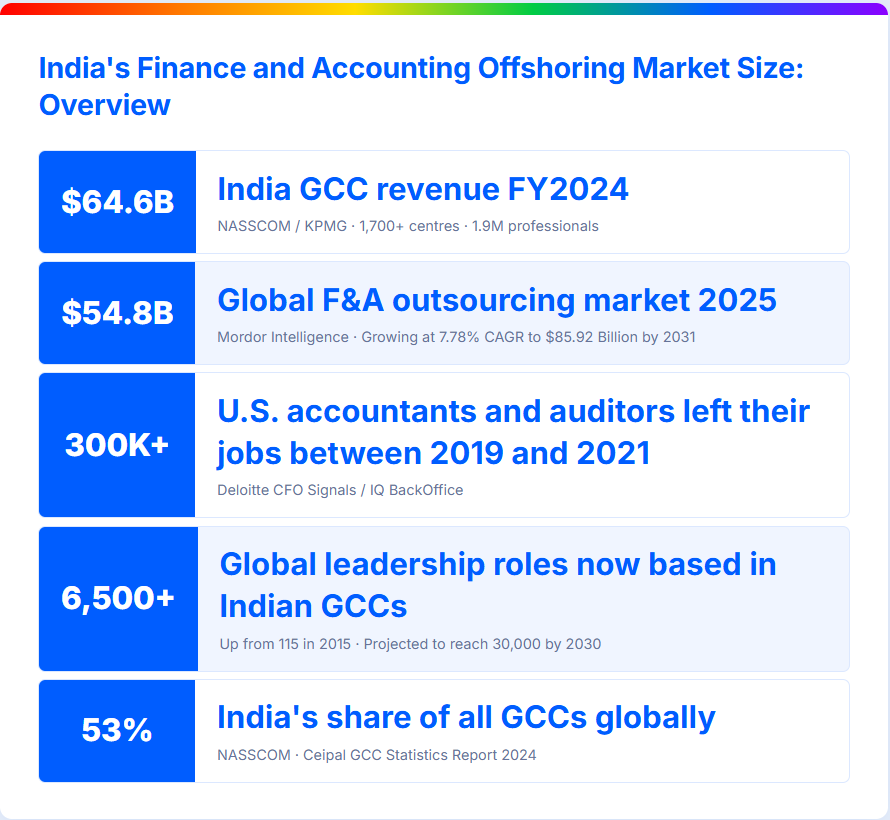
Are GCCs prone to layoffs?
- The GCC ecosystem added roughly 150,000 net jobs last year.
- Layoffs? Estimates put them under 50,000.
- About 90 greenfield GCCs were set up in India last year, adding maybe 10,000–15,000 roles. BFSI alone added 20,000–25,000.
- Most important: The bulk of “new jobs” came from GCCs established since 2010.
What’s happening isn’t a layoff wave. It’s “restructuring”; Transactional roles going out, strategic roles coming in.
Is AI restructuring GCC finance teams?
Remember Twitter’s engineering team? 2,000 people before Elon Musk. Roughly 25–30 after.
That may seem extreme, but the finance side of GCCs is seeing similar disruption.
What’s happening? Transactional finance roles (P2P, O2C, R2R) are rapidly automated.
AI now:
- Reconciles accounts faster than humans
- Processes invoices flawlessly
- Generates variance reports automatically
What survives:
- Deep functional expertise,
- Tech-enabled finance: Finance professionals who can actually drive transformation, not just talk about it.
- Senior stakeholder influence: The kind of person who can convince a global CFO to bring more work to India.
The role most at risk? The “People Manager” who’s just overseeing delivery and managing site operations.
Roles with a high attrition rate?
Attrition remains high in classic customer support and operations roles, but in highly sought-after areas like AI and ML, attrition now exceeds 20%.
GCC salary: Hype vs. reality
At a recent GCC Summit in Bengaluru, a wild claim went around: “A CA earning ₹1 lakh in a traditional company can earn 2–3x in a GCC.”
Wish I could say, it’s true…But that’s misleading.
Large FMCG and PE-backed companies still pay top CAs competitively.
GCCs, however, deliver consistent, compounding growth: 9–10% annual hikes can translate to 30%+ cumulative growth over three years.
Is there really a career ceiling in GCC?
I get this question from senior finance professionals a lot.
Honestly, it depends on what ceiling you are measuring.
Client-facing roles
- If you mean market-facing business development roles at the headquarters, then yes, that ceiling exists.
- Those roles require you to be present in the onshore market. You cannot just expect to deliver that work sitting out of a GCC in India, and that is not going to change.
Non-client-facing core business function.
If you mean the depth of finance work, the seniority of global stakeholder engagement, and the ability to drive enterprise-level transformation from India, then that ceiling is almost non-existent.
Also read: Deloitte’s Romal Shetty says: India’s next biggest job creator? GCCs
Next wave of GCCs
When I started, 80% of my GCC clients were US companies. Today, that’s dropped to 55–60%.
Why? European, Japanese, and Australian firms are moving in fast.
But here’s the twist: not all roads lead to Bengaluru anymore. Talent studies show European clients are now looking at Coimbatore, Kochi, and other Tier 2 cities a conversation that barely existed three years ago.
Why does this matter? In Tier 2 cities, you’re more likely to land a senior leadership role than get lost as a mid-level hire in a saturated hub.
And don’t sleep on mid-market GCCs. Over 60% are PE-backed, meaning aggressive growth plans. The people who join now, while they’re still small, are the ones who will become senior leaders as they scale.
Also read: KPMG GCC India leader unveils big shifts & billion-dollar opportunities
Wrapping up…
I’ve seen very senior CAs (15 to 20 years of experience) whose entire tech exposure was limited to SAP, and that too a few FICO modules…That’s not going to cut it in 2026.
GCCs want you to wear multiple hats at once:
- Drive finance transformation,
- Understand automation, and
- Operate in a technology-enabled finance function.
If you step up, there’s never been a more exciting time to be in the GCC space.


Great would like to be part of GCC in India