 TFS Gulf




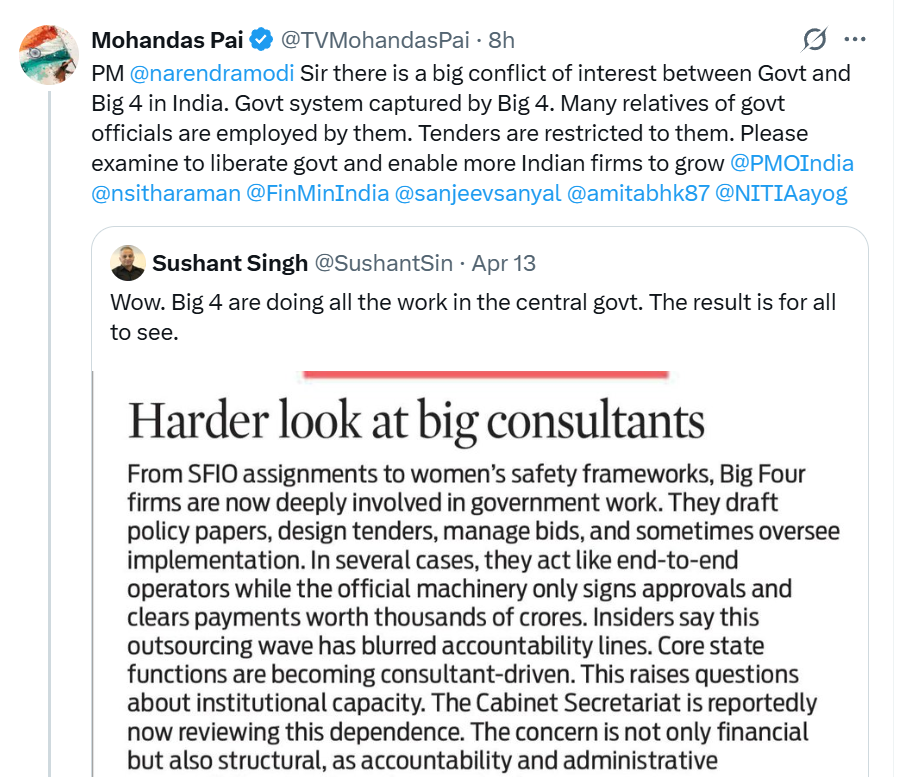
- Ex-Infosys CFO Mohandas Pai took to X with a question the CA fraternity has been asking for a while:
- Why are relatives of government officials on Big 4 payrolls…while these same firms keep winning every major contract?
- Isn’t this a potential conflict of interest?
What’s going on?
Pai’s response came after another post by Sushant Singh, a lecturer at Yale University.
Singh’s post argued that Big 4 firms are becoming increasingly embedded in government operations.
According to his post, key institutions, including the RBI and the Enforcement Directorate, routinely assign them work in investigations, certifications, reconciliations, and accounting.
And the Big 4s are now involved in:
- Drafting policy papers
- Designing tenders
- Managing bids
- Overseeing implementation
They are also increasingly active in sensitive sectors like defence, cyber security, and data management.
The numbers don’t lie
The Indian Express reported that between 2017 and 2022, over 308 government contracts worth ₹500 crore went to Big 4s and McKinsey:
- PwC: 92 contracts worth ₹156 crore
- Deloitte: 59 contracts worth ₹130 crore
- EY: 87 contracts worth ₹88 crore
- KPMG: 66 contracts worth ₹68 crore
- McKinsey: 3 contracts worth ₹50 crore
Roughly 50 government organisations and 16 ministries outsourced work to these firms.
And that’s only what is publicly visible.
Why Big 4’s desperate for Government contracts?
For Access and Influence.
Let us explain.
Senior bureaucrats regulate entire sectors…real estate, infrastructure, aviation, mining, logistics.
When the Big 4 win government contracts, they don’t just earn fees…They gain ACCESS:
- Access to how decisions are made.
- Access to how regulators think.
- Access to who gets heard…and who doesn’t.
The crores in government fees? That’s not the prize.
The prize is knowing what India’s government is going to do…before India does.
There is another angle…
A Partner at one of these firms admitted as much: “Big 4s often end up acting as a mediator between Corporations and the Government ecosystem.”
So the same firm advising MNCs is also advising the government on the exact policy that affects that multinational.
In short, Corporate interests quietly start shaping government decisions/policies…Making it all about INFLUENCE.
According to an ex-IAS officer, this only raises concerns about the Big 4’s influence on policymaking.
Also read: CA firms struggling in “peanut earnings” trap. Is CA Degree wasted on Compliances?
Is this hurting Indian CA Firms?
Critics point out that the system is rigged in favour of the Big 4s.
Madhukar Hiregange, Council Member at ICAI and Founder of the 700+ member firm H N A & Co., in a previous conversation with The Finance Story, explains why:
The Big 4 have a stranglehold on government contracts. Most large government tenders often come with almost unattainable criteria:
- High turnover requirements ( To even bid for most government contracts, a firm needs ₹500 crore in turnover!)
- Large headcount thresholds
- Strict past-experience conditions
On paper, it’s about “quality control.” In reality, it often shrinks the field to a few global players.
Here is an example by a Senior Partner at a top-20 Indian firm:
“Recently, there was a government RFQ (tender) for a forensic audit.
One condition required attaching at least five court decisions based on the forensic reports of the applicant firm.
These cases go on for 10, 15, or even 25 years…so how can we have 5 court decisions?
We are a 1000+ member firm, with the capability and required bandwidth to handle this assignment…but because of this one condition, we did not qualify.”
Well, nobody wrote that condition by accident.
Another senior partner added, “Many tenders are designed in a way that only Big 4 firms can qualify. Some changes have happened, but not enough to matter.”
There is a need for change
Several insiders we spoke to pointed to the same fixes:
- Drop the turnover requirement. Judge firms on their partners’ experience and continuity instead
- Match resource requirements to the actual job, not arbitrary headcount minimums
- Check whether the firm or its partners have faced enquiries (this matters more than size)
- Assess capability through listed company experience, not office square footage
- Rationalising software requirements mandating 7+ tools when 2 or 3 do the job is just a filter disguised as a standard
- Use ICAI’s own frameworks: Peer Review and AQMM already exist. Make them the baseline.
Also read: Dear CA Firms, 950+ listed companies to change Auditors….Well, Big 6 wins
Wrapping up…
PM Modi announced the “Desi Big 4” dream in 2017.
Nearly ten years later…Well, we are still waiting.
As Madhukar Hiregange puts it, “While I think the Government’s Desi Big 4 initiative is fantastic, the system is still heavily influenced by the Big 4.”
Nobody’s claiming conspiracy. But when the same firms:
- advise the government
- help design tender structures
- consistently win the resulting contracts
- and quietly taking care of the right people
…it becomes difficult to treat it as a coincidence alone.
As long as the rules keep favouring firms that already have everything…that Desi Big 4 dream isn’t going anywhere anytime soon!

