 TFS Gulf



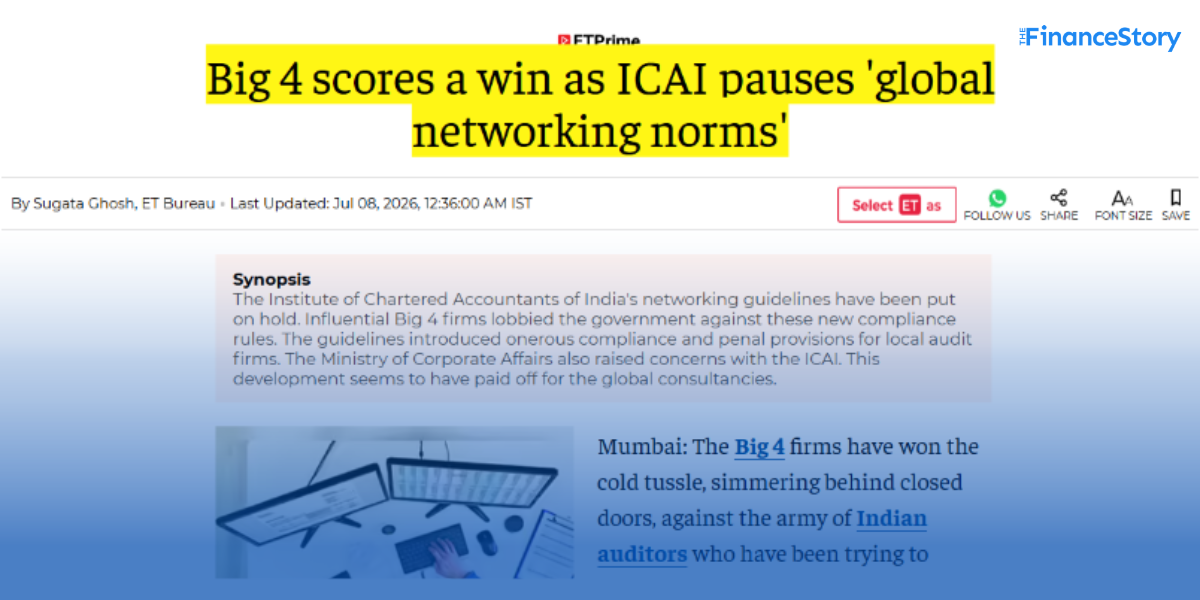
- ICAI announced the ‘Global networking guidelines 2025’, and now Big 4 is lobbying the government vehemently to put an end to it.
- Why? The guidelines require foreign firms with audit affiliates to disclose partnership details such as cost/revenue sharing.
- And as per ET, the Big 4 didn’t like the idea.
- Ministry of Corporate Affairs (MCA) is saying that imposing regulatory frameworks is not ICAI’s job.
Problem ICAI wanted to solve
Technically, the Big 4, or any other foreign accounting firms, are not allowed to provide statutory audits to Indian entities.
However, they can “indirectly” do so by forming alliances with local CA firms, aka “Their audit affiliates”…It turned out to be a win-win situation.
While the Big 4 expanded their market share, these domestic affiliates got access to the “Big 4 brand”, cutting-edge tools, and global clients.
But there was one glaring problem….There were no clear rules governing how these international partnerships actually operated.
This meant smaller and mid-sized Indian CA firms found it far more difficult to build similar global alliances.
And ICAI wanted to change that
In 2025, ICAI came up with “Global Networking Guidelines”- the first formal and well-structured framework for international partnerships.
In February 2026, the guidelines became official.
See, the ICAI’s goal for introducing the framework was straightforward:
- Create a level playing field by letting domestic firms formalise international affiliations.
- And at the same time, require all global networks operating in India to be more compliant and transparent, bringing them under ICAI oversight.
According to the guidelines, the firms with Indian audit firm affiliates had to:
- Register their Global Network (along with an approved name) with the ICAI
- Appoint a nodal officer who holds a full-time Certificate of Practice from ICAI
- Maintain strict independence by not providing non-audit services to the international network’s audit clients.
- And the big one….Disclose all the commercial partnership arrangements in an annual filing when called upon by the ICAI.
Also read: Big 4s romance Babus…hiring relatives, winning government tenders
That’s where things got messy
According to an exclusive report by The Economic Times, there was one compliance requirement that Big 4 didn’t quite like…An annual disclosure of all the commercial arrangements with their local affiliated firms.
We’re talking,
- Revenue Sharing
- Cost Allocations
- Royalty payments,
- Technology licensing agreements,
- Fee-sharing mechanisms
ET revealed that the Big 4 wasted no time in calling on the government, citing data leak concerns.
What happened next?
Big 4 started panicking and lobbying.
According to an article by ETCFO, India’s Ministry of Corporate Affairs (MCA) intervened, claiming that imposing regulatory frameworks is simply not the ICAI’s job… It’s the government’s.
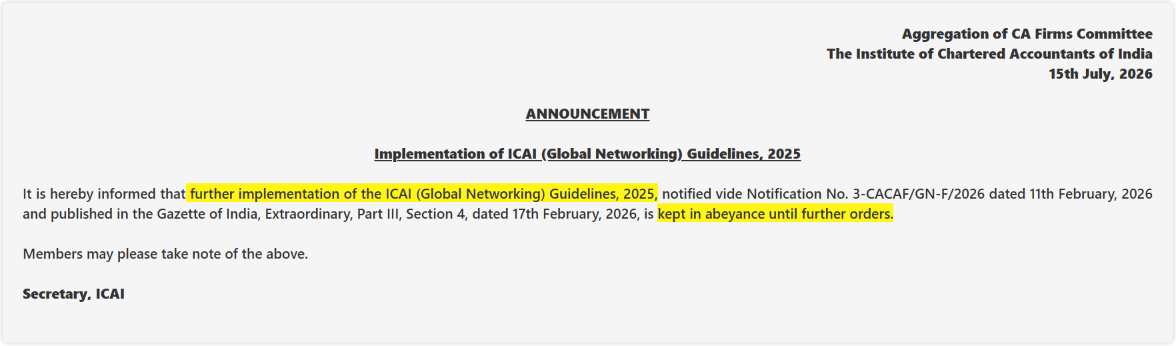
As it turns out, the ICAI has hit the brakes on the guidelines, and nobody knows for how long.
ICAI’s president, Prasanna Kumar, and several MCA senior officials are scheduled to assemble for a meeting in the coming weeks, as per ET.
Industry experts are heavily criticising this decision
Many CAs and audit firms stormed social media, calling out this decision.
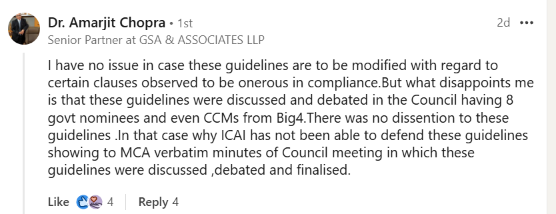
Dr Amarjit Chopra, Senior Partner at GSA & ASSOCIATES LLP (ICAI President 2010–11), took to LinkedIn to let it all out,
“What disappoints me is that these guidelines were discussed and debated in the Council having 8 govt. nominees and even CCMs from Big4.
There was no dissension to these guidelines. In that case, why has ICAI not been able to defend these guidelines, showing to MCA verbatim minutes of the Council meeting in which these guidelines were discussed, debated and finalised?”
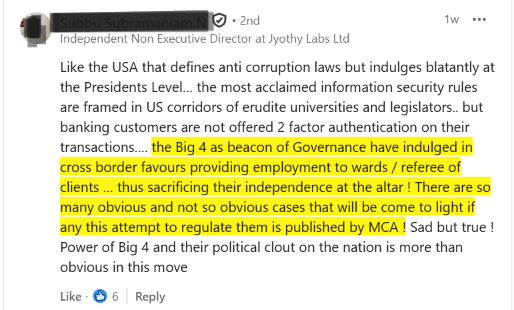
Another CA firm founder took to LinkedIn to point out the double standards,
“Can a regulated tell the regulator that he, i.e., the regulated, is not comfortable disclosing his international network arrangements because they are business secrets?”
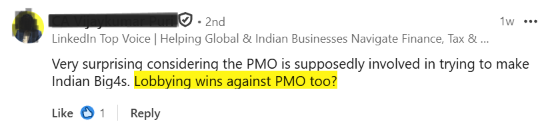
Wrapping up…
But wait, this is not the first time that the Big 4 has received preferential treatment from the government.
Big 4 have long maintained a cosy relationship with the Government.
Madhukar Hiregange, a Council Member at ICAI, himself told us in a previous interview that the Big 4 build these relationships by helping bureaucrats’ families with global placements.
The result? The Indian Express reported that between 2017 and 2022, over 308 government contracts worth ₹500 crore went to Big 4s and McKinsey.
Winning the audit rotation game
Due to the Big 4’s monopoly, it accounted for roughly 29% of total audit fees among NSE-listed companies in FY24–25. And with the next audit rotation cycle on the horizon, experts estimate that only about 10% of audit mandates may move outside the Big 4/6 ecosystem.
That brings us to the question…Who is actually shaping India’s audit market, the ICAI or the Big 4?

