 TFS Gulf




- In a viral LinkedIn post, Alex Mann, a tax technology recruiter, highlighted a trend that would have been hard to imagine a decade ago: mid-tier and boutique firms are starting to win enterprise-level tax work that once seemed firmly in Big 4 territory.
- Then came the example that really caught our attention.
- A small tax boutique with no external funding, built largely on reputation and referrals, convinced one of the world’s biggest MNCs to “waive its Big 4-only” vendor policy and bring them in.
What’s driving this disruption?
The advisory market is unbundling, powered by three major forces:
Technology is the great equaliser
A five-person tax team with the right expertise and proprietary technology can now potentially deliver work that once needed a much larger team.
You don’t always need an army of consultants when technology can do more of the heavy lifting.
Clients want experts
Clients are often hiring the people and relationships, not simply the Big 4 brand.
Smaller tax firms can offer something clients value: direct access to senior experts, deeper specialist knowledge and fewer layers between the client and the person doing the work.
In tax, that can make a big difference.
According to Mann, letterheads matter less; what matters is delivery.
Agility Over Infrastructure
Challenger firms, many of which are backed by Private Equity, are building transformation practices from scratch.
They are now pushing into enterprise-level work….Well, without the legacy infrastructure of the established players.
Also Read: Ex-Big 4 Leaders, AI & Private Equity are going to disrupt Tax Advisory?
And people on LinkedIn had plenty to say
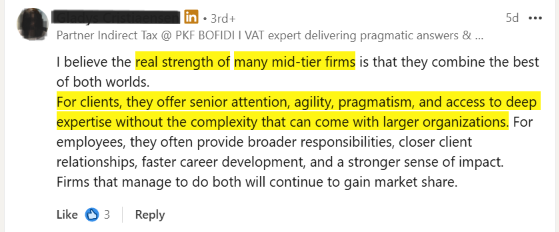
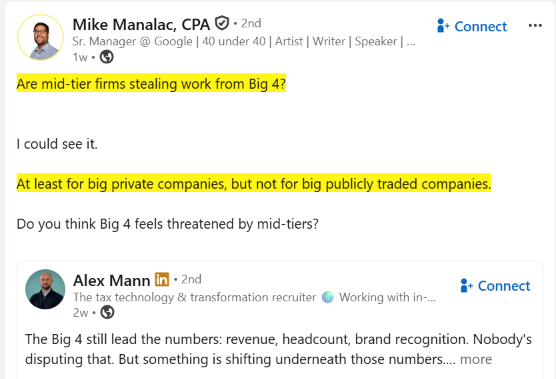
Is this happening in India?
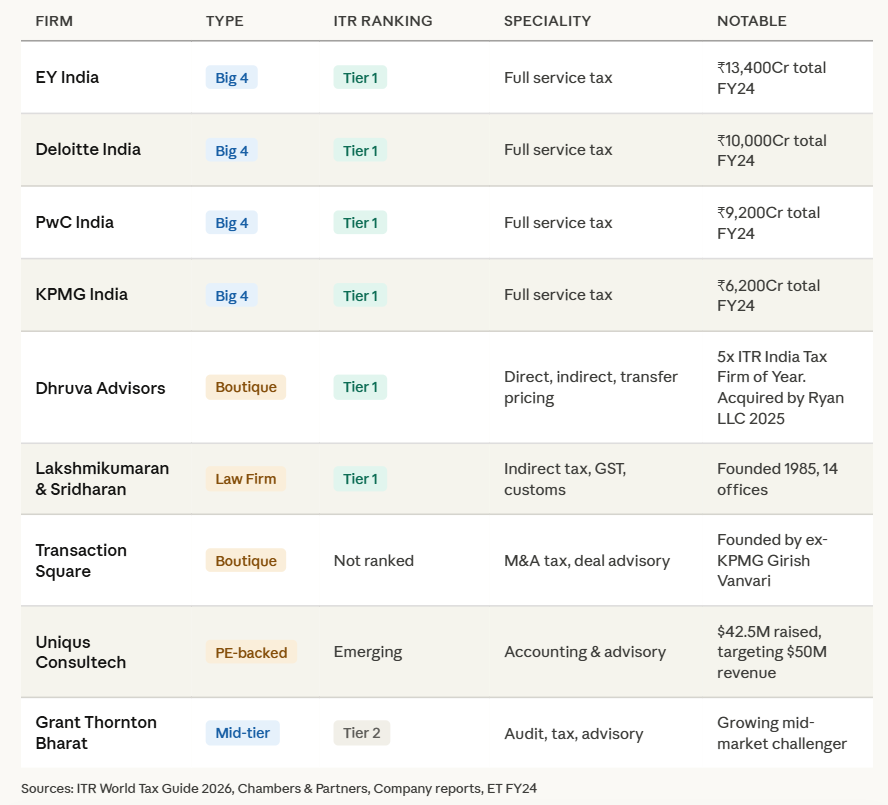
India has seen an explosion of top-tier firms founded by former Big 4 partners.
Be it: Dhruva (Ex-KPMG Deputy CEO), Transaction Square (Ex- KPMG Tax Partner), Aurtus (Vishal Gada), Aeka Advisors (Abhishek Goenka), and there are many more.
So yes, the Indian market is rapidly unbundling.
For complex cross-border tech transformations or massive listed audits, the Big 4 remain dominant.
But for specialised tax structuring, M&A advisory, and mid-market execution, Indian CFOs no longer view the Big 4 brand as mandatory; they view it as a luxury, choosing specialised execution over expensive letterheads.
Audit rotation is also playing a big role.
Once a Big 4 firm is forced out as an auditor, companies often try mid-tier alternatives rather than simply rotating to another Big 4 firm.
This isn’t collapse of the Big 4
Big 4s still hold the lion’s share of revenue, headcount, and global infrastructure.
Alex Mann acknowledges there is a “big mountain to climb” before this translates into major market-share changes.
But as he points out, the redistribution of market power has already begun.
The takeaway is loud and clear: Corporate buying behaviour is fundamentally changing.
Real question is: How long can Big 4s hold out when specialised, high-tech boutiques deliver better results for less?
