 TFS Gulf




- We interviewed several ambitious Big 4 Managers and Associate Directors in India.
- Look, we expected some frustration…But what we didn’t expect was how many of them were actively looking for an EXIT.
- The BIG question is, WHY!
Too many Directors, too few Partner seats
Making partner at a Big 4 firm is becoming increasingly rare and unpredictable.
No, it’s not like people don’t want to make Partner. Plenty are chasing it. The problem? There are just far more contenders than available Partner seats.
One insider described the situation in EY’s corporate tax practice:
“Around 15 to 20 directors are competing for 1 or 2 partnership positions, and some years, even those roles don’t open up.”
Similar patterns are being observed across firms.
An Associate Director at PwC said,” In a decade, only a ‘single individual’ in their team had made partner…So you wait and wait and wait some more.”
A Deloitte Manager told us, “Partner promotions during his tenure were reserved for senior candidates, leaving little room for younger talent.”
At the same time, the Big 4 is increasingly open to hiring lateral partners, further narrowing internal promotion opportunities.
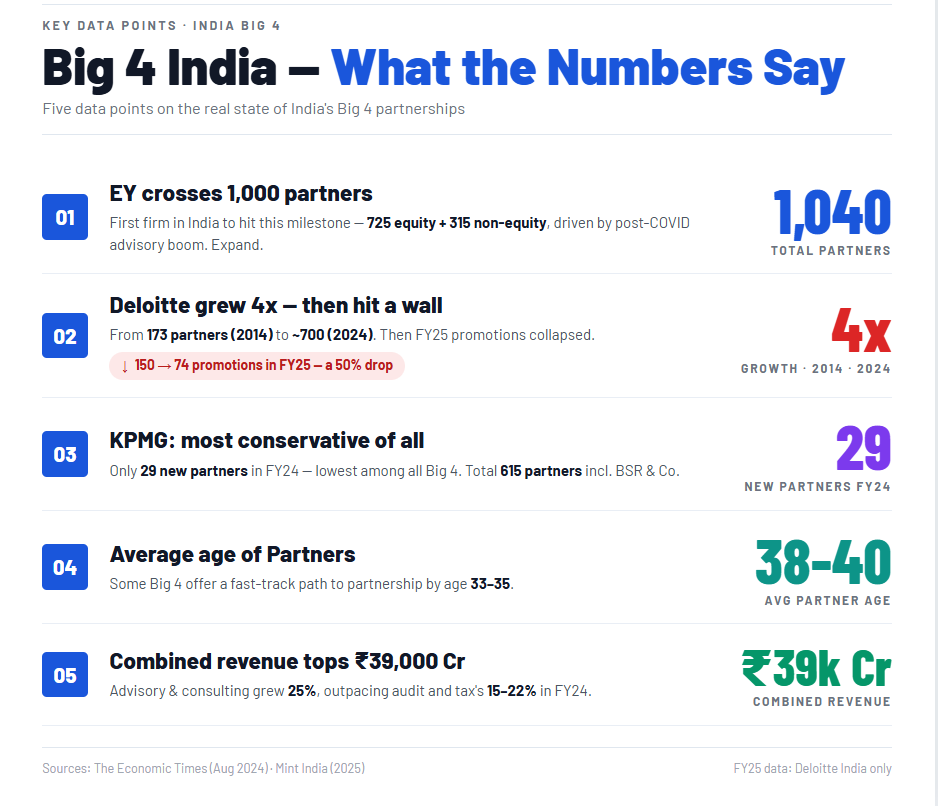
In FY 2025, the number of Partner promotions at Deloitte India dropped by 50%.
The “non-equity” Partner trap
Even if you make it, there’s a catch.
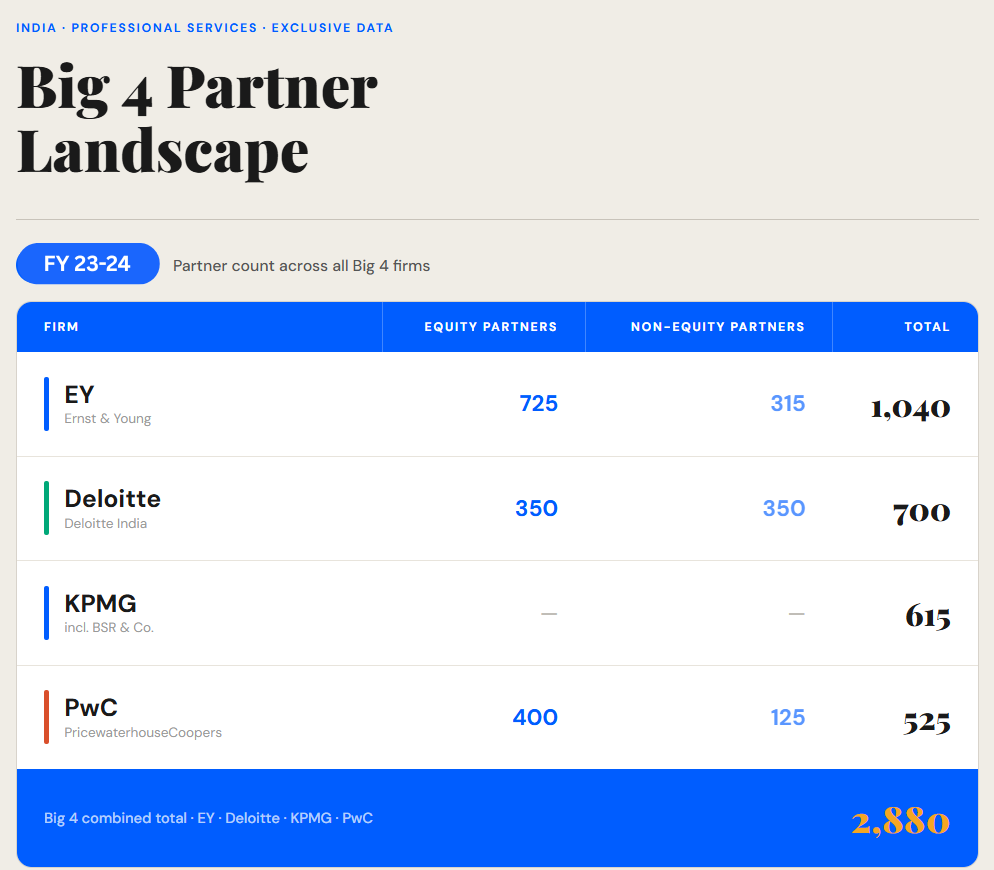
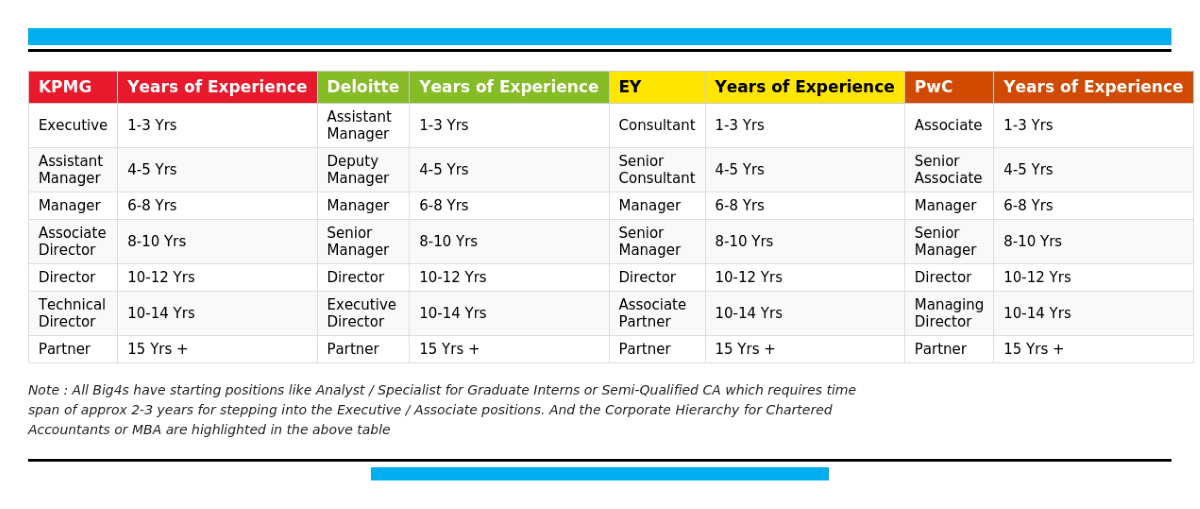
Firms are increasingly using non-equity partner roles (Managing Director or Associate Partner positions), which offer senior designations without a share in firm profits.
As one insider put it: “You’re a very expensive, tired project manager with a better email signature.”
Oh well, you’re still under a microscope. That’s one of the biggest reasons people are moving.
Not all service lines are created equally!
If you aren’t in a high-margin niche, you’re likely stuck in the “commodity” trap where the firm simply cannot afford to make new partners.
Workload tripled. Salaries? Not so much
One Manager told us: “I work 10 am to 12 am every single day… for ₹30L a year. Is this a joke?”
Another insider who quit said, “I was an Associate Director during COVID. The Director above me, who was 5–6 years my senior, was earning only about 5% more than I was.”
Adjust for inflation, and many are earning less than the previous generation while working more.
One insider says, “After 8 years, I hit burnout. In the last 3–4 years, attrition has exploded. People are prioritising work–life balance.”
A Deloitte Partner managing a Gen Z-heavy team said,
“Today, most join the Big 4 to gain skills, a brand name and then quit!
Big 4s are a launchpad…Not a destination. They also fight back against long working hours.”
Also read: Big 4 promotions are far more political & often hinge on your manager’s influence
System punishes its best people
One of the Deloitte Associate Directors we spoke to was exceptional at delivery (the highest bonus for two years running).
But her partner kept her locked in delivery work. Why? She was too good at it.
She was never given exposure to business development, the very thing needed to make partner.
She quit.
Then there is office politics
One partner admitted it openly: “The Big 4 are built on ‘The Story’. Senior leadership often notices and rewards bold storytelling.”
As one Associate Director who recently quit nicely put it:
“The path up to Associate Director is quite straightforward. If you have merit, work hard, and are technically strong, you can make it.
But after that, things get more complicated, and further promotions depend on many non-technical factors, not just hard work and merit.
Doesn’t matter if you clock 16 hours daily…If your chemistry doesn’t match the partner’s way of working, you are done.
And for women?
A Big 4 Associate Director we spoke to brought up gender unprompted.
“It’s even harder for women.
Not because somebody is plotting against them, but because the system is designed that way.
The Big 4 is structured for someone who can dedicate everything to work….No family obligations, no divided attention, no compromise.”
Also read: Big 4 Partner at 32: The Secret? Clarity & not chasing every 2x job offer
So where is everyone going…
- Startups
- VCs and in-house finance functions
- GCCs and overseas roles
- Mid-tier or boutique consulting firms
- PE-backed advisory firms offering equity upside and faster growth
One HR leader shared:
“A tax role in Bangalore received 250 applications in 24 hours…90% were Big 4 alumni.”
A 28-year-old Big 4 Senior Manager put it simply: “In-house finance functions are getting stronger. The lines between industry and consulting are blurring fast.”
Wrapping up…
Earlier, the path to partnership was a ladder. It took a good 12–15 years to reach the Partner level, if you were exceptional.
Today, it’s a bottleneck as firms have added filler designations:
- Associate Director
- Associate Partner
Why? To manage the sheer volume of talent, essentially, “waiting rooms” are disguised as a designation.
Now the journey routinely stretches to 15–18 years if you are lucky…Many are realising that the ROI on staying is declining.
- Big 4? Still good for experience and brand points.
- Partnership? Still prestigious.
- But the grind, politics, and long ladder? Too much for most.
People aren’t afraid of hard work; they’re just tired of sacrificing everything for a promotion that depends more on luck than talent.
And remember, Big 4 teams are structured like a pyramid, so there’s very little room at the top.
FAQs
How long does it take to make partner at a Big 4?
It usually takes 15–18 years of career progression. However, there have been multiple instances where
people made partner within just 10 years.
Is it harder to become a Big 4 partner in India?
Yes.
Since partnership slots are limited and highly competitive, it is indeed becoming quite difficult to
make partner.
Even candidates who bring in revenue, build client relationships, and even lead large Teams, sometimes, can get overlooked for partner promotion.
How to become a Big 4 partner?
- You must build a strong client network
- Generate revenue
- Have leadership and team-building skills
- Deep technical expertise (audit, tax, consulting, etc.)
- Track record of winning large engagements
- And most importantly, play the office politics game, right?
Is there “Office Politics” in the Big 4?
Yes. Not just the Big 4. But it’s everywhere in the corporate world. It’s all about visibility and relationships:
- Who knows your work?
- Can you navigate partner dynamics?
- Are you aligned with leadership priorities?
- Stakeholder dynamics
- Client relationships and a lot more


What is the future of ACCA qualified accountants in big 4