 TFS Gulf




- PwC is in a legal fight with its ex-partners who joined PE-backed Unity Advisory, founded by ex-PwC COO.
- The Big 4 alleges that former partners violated their partnership agreements.
- But zoom out, and this isn’t new.
- The big question: Are PE-backed boutiques now a real threat to the Big 4?
What is happening?
In Feb 2024, PwC UK COO Marissa Thomas exited after being passed over for the Senior Partner role.
And in 2025, she teamed up with ex-EY UK Chairman Steve Varley to launch Unity Advisory, backed by $300M PE.
In an industry dominated by the Big 4, Unity made a deliberate strategic choice:
- Stay entirely out of audit. By remaining conflict-free, they focused exclusively on consulting.
- To build quickly, they brought in PE giant Warburg Pincus, which wrote a $300 million cheque to back the venture.
- The founders made it clear that their ambition was to peel away clients and partners from the Big 4s, according to reports in the Financial Times.
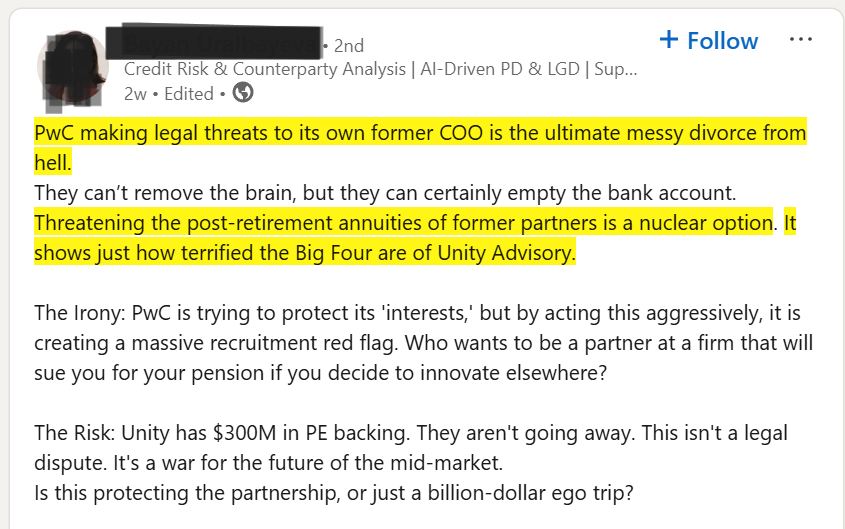
Fast forward to Feb 2026: reports emerged that PwC had sent legal warning letters to “former PwC Partners” who joined Unity.
The bigger shock…PwC warned these former partners that:
- Post-retirement annuities (sometimes over $1Mn)
- Healthcare benefits…could be withheld!
But hello, Partner exits have always happened…Clients have always followed. What’s the big deal now?
So, then why is PwC escalating this publicly?
The Finance Story exclusively spoke to several insiders. And they were pretty blunt about it.
Big 4s aren’t just fighting ex-partners. They’re fighting Private Equity, which is flooding professional services firms with capital at SCALE!
Earlier, the top Big 4 talent had to choose between another Big 4 firm or take the risk of going independent.
Now, Partners have a third path: joining PE-backed advisory firms that offer:
- real equity upside,
- faster growth,
- and genuine wealth creation.
And once enough partners take that door, the best people start leaving…and clients follow.
Let’s not forget that PE-backed firms are now a real mid-market threat to the Big 4.
But how effective are Big 4’s non-compete agreements?
We spoke to a veteran Big 4 Partner in India who has seen multiple high-profile exits.
In 2009, around 200 people walked out of PwC India and joined KPMG.
PwC tried everything: new partner teams, account coverage, and garden leave. It didn’t matter.
“The clients still moved. It’s all about the relationships you built, not the logo on the door.”
What about the “no poaching clients” clause? Almost impossible to enforce.
Think about it practically. “Can any firm stop me from meeting a client for a cup of tea outside the office? How do you prove that’s poaching? You can’t.”
Another Big 4 leader told us, “From my experience, clients and employees often follow the departing partner.
During garden leave, typically 3–6 months, the partner cannot work on the same clients.
But here’s the practical reality: smart firms bring in the former partner as a mentor or QRP (Qualified Replacement Partner) at the new firm. This partner acts as a mentor. Once the garden leave ends, the departing partner formally takes over the client relationship.”
Verdict?
- Non-competes and legal actions are rarely enforceable in practice.
- The law hates restraint of trade. You genuinely cannot stop someone from earning a living. Broad non-competes get laughed out of court.
Also read: Ex-Stripe exec $27.5Mn fundraise to acquire tax & accounting firms, challenge Big 4
Could similar tensions emerge in India?
India has already seen several senior Big Four leaders leave to build successful advisory firms of their own.
Of course, these transitions were largely structured exits: garden leave, adherence to partnership agreements, and clean exits.
But as more PE money flows, expect…
- Future exits to become more contentious
- Big 4 firms writing tougher contracts
- Garden leave pushed toward 12 months
- Tighter non-solicitation clauses (Naming specific clients, more post-retirement benefits tied to compliance, and larger capital holdbacks as a deterrent)
Wrapping up…
Non-compete agreements are good for two things: creating fear and harassment.
Every partner has money sitting inside the firm, sometimes the equivalent of two or three years’ salary.
“They won’t pay your capital for a year or two. That’s harassment enough.”
That’s the real weapon…The financial squeeze.
And yes, Big 4 vs PE-backed challengers is no longer a theory. It’s here.
FAQs
How does the Big 4 non-solicitation agreement work?
It’s a contract provision in firms like PwC, Deloitte, EY and KPMG.
So, when a partner leaves, they usually cannot approach the firm’s clients or employees for a certain period (often 12–24 months).
What is the Big 4 non-compete agreement?
A non-compete agreement in Big 4s is a contractual term preventing staff and partners from joining a competing firm within 6–12 months (varies by country and contract).
What is the Big 4’s garden leave?
Garden leave is a notice period (generally 3 to 6 months, though it can vary).
During this period, the partner does not attend the workplace but continues to receive compensation and benefits. It protects the firm’s confidential information, client relationships, and business strategies.
Is it tough to exit the Big 4 as a partner?
It’s much harder to leave the Big 4 as a senior leader than as an employee.
Reasons: Partners must follow strict non-compete and non-solicitation clauses. They may have capital invested in the partnership. Some contracts include financial penalties if rules are breached

