 TFS Gulf



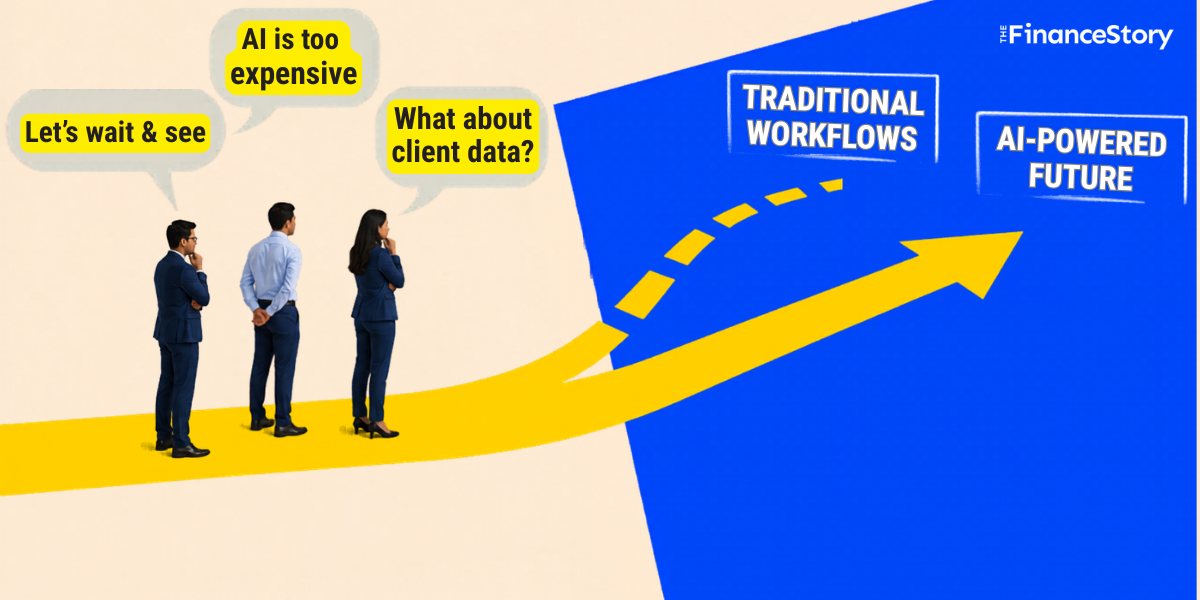
- Big 4 firms like Deloitte are quietly moving down-market, targeting India’s 75 million MSMEs.
- Mid-sized & smaller CA firms are suddenly facing a new kind of competition: AI-powered Big 4 “platforms” offering faster, cheaper advisory at scale.
- So what does this mean for CA Firms? What should they be doing?
Visible psychological shift among clients
A mid-market Chief Financial Officer (CFO) summed up the situation:
“If I can get a PwC or Grant Thornton opinion at the price of a mid-sized firm, why would I look anywhere else?”
According to Chirag Baid, an ex-Big 4 professional, the trust is slowly shifting from Individuals to Platforms!
Also read: Dear CA Firms, 950+ listed companies to change Auditors….Well, Big 6 wins
CA firms are not relaxed in the face of AI
Vijay Krishna, a founder building AI for India’s audit ecosystem, gave us proof: “You’d be surprised. Beyond engineering, I haven’t seen any other profession trying to adopt AI as aggressively as the CA fraternity.
ICAI created an AI roadmap, launched CA GPT (with strong adoption) as an initial step, and is now running AI certification programs at scale. They’ve already conducted close to 1,000 batches, and the new cohorts fill up within hours of opening.
There are CA AI hackathons, showcasing AI workflows, and a large upcoming AI summit with over 3,500 participants.
As you very well know, an audit is a uniquely difficult environment. Firms don’t control the quality or structure of inputs. Incoming data is fragmented. At the same time, firms are short-staffed and struggling to find quality articles.
So the drive toward AI is more of a practical necessity than a nice-to-have one.”
Pranjal Garg, another founder of an AI/ML-powered Treasury Automation Software, tells us,
“CA firms that I have spoken to are genuinely interested in automating clerical, repetitive work. The stuff that interns usually handle.”
Another CA Firm Managing Partner told us, “As a firm, we’ve been investing in AI to transform our entire audit planning process, where one can feed the financials into AI and it maps out all the risks.
Automated invoice matching, PO, GRN, and risk mapping are some real use cases of AI that can save a lot of time.”
But here’s the problem…
One founder told us, “Most firms think they are AI-driven because they use ChatGPT or Claude.”
He added, “Smaller CA firms in India are still not too keen on…AI workflows.”
And inside many firms, the same objections keep surfacing:
- “Clients trust us personally.”
- “We survived Excel and cloud computing. We’ll survive this, too.”
- “AI makes mistakes.”
In short? Most firms are still experimenting with prompts…but NOT rebuilding delivery systems around AI.
Also read: Ex-Big 4 Leaders, AI & Private Equity are going to disrupt Tax Advisory?
So what should CA firms do?
Yes, Bigger firms are weaponising AI to become faster and cheaper.
But when an MSME signs up for a low-cost AI subscription with a large firm, what do they often get?
- A polished dashboard
- Automated reports
- But access to a partner…Nope!
And that is where small and mid-sized firms still have an advantage!
CA Firms should redesign themselves
AI handles 60–70% of deliveries, and Partners focus on judgment, review, and client relationships.
Shift to standardisation
a “one firm, one voice” system:
- Shared knowledge base
- Consistent delivery across partners
- AI-backed insights layer
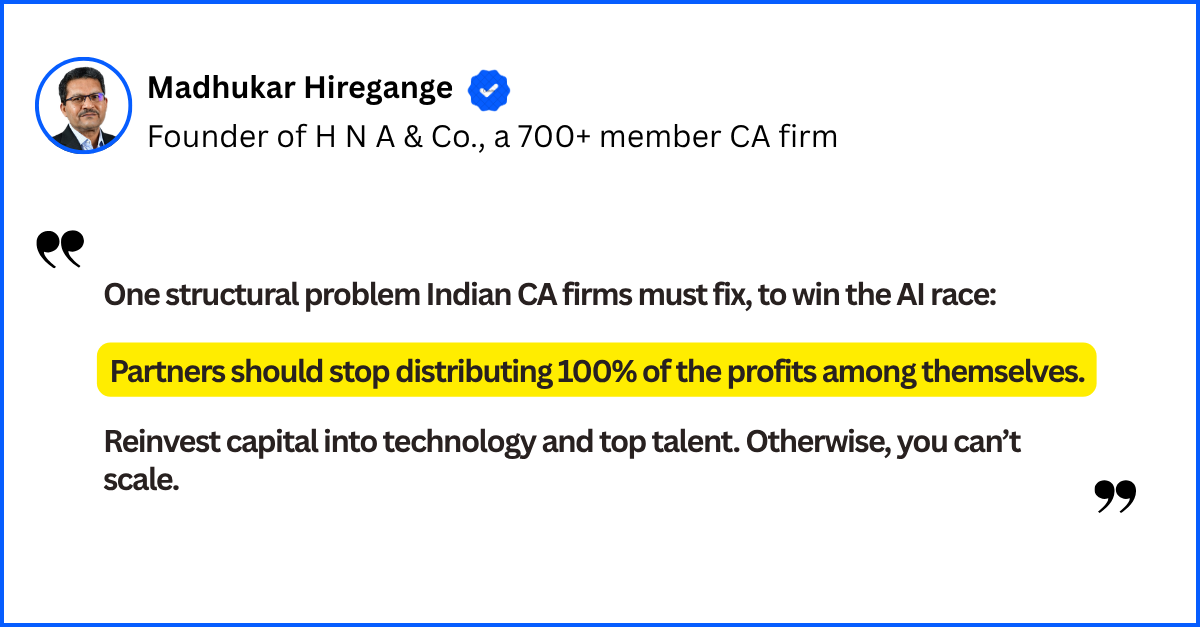
Fix the partner problem
For decades, partners built careers by becoming the definitive voice on FEMA, cross-border M&A, or Indirect Tax…That intellectual edge is being commoditised fast.
The partners most at risk are the deep subject matter experts who were never trained to think commercially.
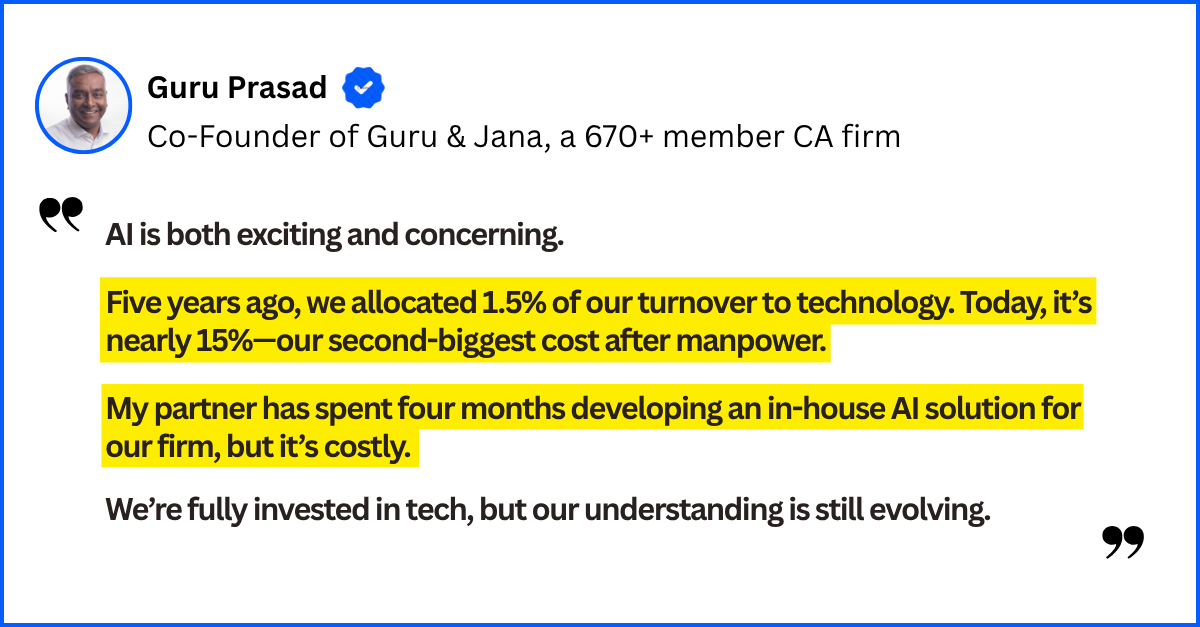
Invest in technology
The good news?
We all know workflow tools, training, integration…None of it is free.
CA firms can’t even access the PE capital route that US firms are using to fund their AI transition. They’re on their own.
AI doesn’t level the playing field in India.
But Firms do not need to build proprietary code. The market is flooded with low-cost vertical AI tools, open-source LLMs, and free tools.
As one CA firm partner explained it perfectly:
“Now there are hundreds of audit tools available, including Assure AI and tools provided by ICAI, free of cost. The question is no longer whether technology exists. The question is whether firms are willing to implement it.”
FAQs
Will AI replace CA firms in India?
No, but it will replace CA firms that don’t adapt.
AI is automating research, compliance workflows, drafting, and first-level analysis.
Firms that use AI to free up time for deeper client relationships will survive.
Firms that don’t will lose clients to Big 4 firms offering AI-powered services at MSME-friendly prices.
What AI tools can Indian CA firms use?
Beyond the big names like ChatGPT and Claude, India-specific tools are emerging for GST automation, invoice processing, and audit workflows.
Open-source LLMs are also a cost-effective option.
The key is moving beyond occasional ChatGPT prompts to actually rebuilding workflows around AI.
This is what we’re hearing on the ground. But we know we don’t have the full picture. What are you actually seeing? What’s working?

