 TFS Gulf




- Hi, I’m Atul Deshmukh. I head the International Assurance & Advisory Practice at KNAV, a firm with over 500+ team members and $50 Mn+ in revenue.
- Over the last two years, we’ve expanded into the UK, the Netherlands, Singapore, and most recently, the UAE…All through majority stake acquisitions.
- But this article isn’t a victory lap about our expansion. It’s about the “black box” of our industry: “How accounting firms are actually valued.”
Backstory: Why we chose acquisitions
KNAV started as a specialist in the US-India corridor.
But as our clients scaled to the UK, Canada, and the UAE, we faced a binary choice:
- Refer the work away
- Or build the capability ourselves…We chose to build!
In regulated markets, “building from scratch” can be too slow. Acquisitions were our accelerator.
Our acquisitions:
United Kingdom: We began with a joint venture and then moved to full integration.
Netherlands: A similar path, JV structure first, then merger.
Singapore: We acquired Natarajan & Swaminathan, a 70-year-old firm. This was independently scouted.
UAE: The introduction of corporate tax, fintech growth, hedge fund structures, and relocations from the UK led to the demand for audit, tax structuring, transaction advisory, governance, and compliance in the UAE.
KNAV saw the window and decided not to miss it.
In early 2024, Sumeet Nayyar (CEO, Affiniax Partners) met Nishta Sharma (CEO, KNAV Advisory US) and Vaibhav Manek (CEO, KNAV India) at an Allinial Global conference in Singapore.
At that point, it was simply an exchange of ideas.
Operationally, Affiniax (also an Allinial member firm) was already our go-to partner in the UAE for multinational client requirements.
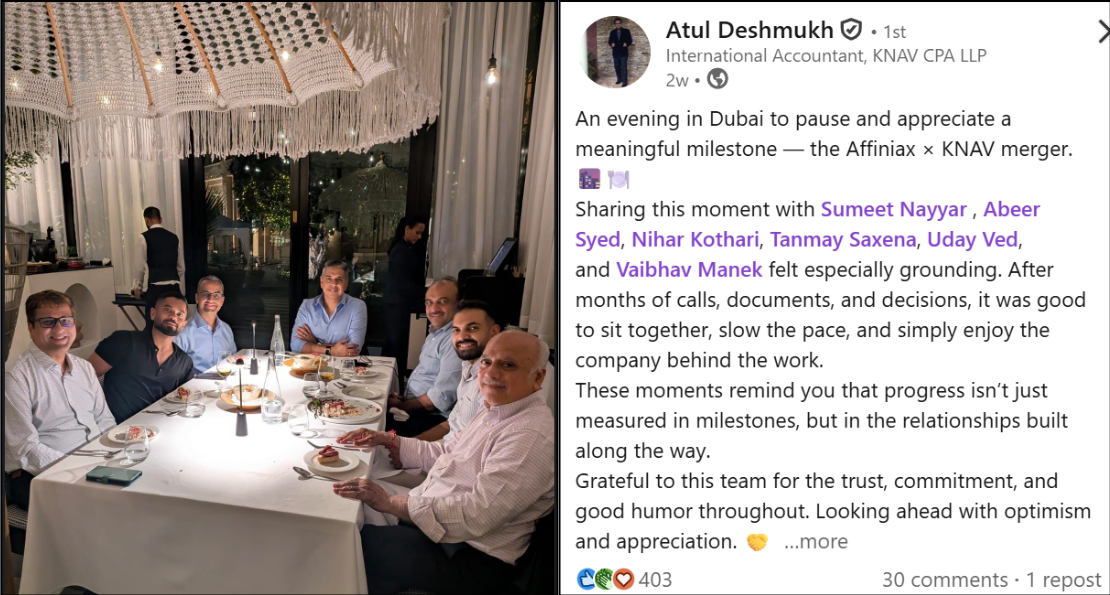
Over time, our relationship evolved, and in January 2026, we acquired a majority stake in Affiniax Partners, a 90-member firm including 65 in the UAE and the rest supported by an Indian delivery team.
How do we actually value accounting firms?
In India, M&A is heating up, but many founders are looking at “vanity” numbers.
Here’s how we look at it.
We don’t look at “vanity” EBITDA
I’ve sat in rooms where partners brag about 30% margins.
But when you look closer, the partners are not drawing a market-rate salary. They are taking “leftovers” and calling it profit.
Partners need to be paid a fair market salary before you calculate EBITDA.
Without that adjustment, EBITDA can look artificially high.
Net income in absolute terms
A firm might have a strong EBITDA margin. But if it only generates $300,000 in net income, it doesn’t move the needle from an acquisition perspective.
Talent composition matters too
Revenue per employee tells us how productive and efficient the firm is.
The ratio of licensed professionals (CPAs, Chartered Accountants) to unlicensed staff is a key value driver.
Recurring vs Transactional Revenue
Not all revenue is equal.
- Audit and compliance-heavy firms typically have more recurring income: stable, predictable cash flows.
- Advisory-heavy firms may generate higher margins, but with more volatility.
For non-recurring work, we ask a simple question: “Are the same clients coming back every year?”
If the answer is no, risk increases.
The 4x–6x Benchmark
Globally, for firms under roughly $8 million in revenue, offers typically range between 4x to 6x EBITDA after adjusting for partner compensation.
That’s the broad benchmark.
But deals aren’t made on multiples alone. They’re made for durability.
At KNAV, we typically look for firms generating at least $1 million in net income and around $5 million in revenue.
Also read: CA Firms Kirtane & Pandit, Guru & Jana, SSKM unite to build India’s Next Big Global Consulting Firm
The acquisition process
From start to finish, the process took around six months to complete.
Here is how others can approach it.
Define your why
Before you even look at a target firm, you need clarity on why you want to acquire.
- Is it their service lines?
- Their team?
- Or their client base?
The sourcing: We don’t leave it to chance
Once we’re clear on what we’re looking for, we don’t “wait and see what comes.”
We build a pipeline.
We put experienced deal originators on retainers whose only mandate is this: Find the right firm.
Of course, we give them our size criteria and walk them through the parameters we care about.
Sometimes, after months of exploration, the conclusion isn’t an acquisition at all…It’s hiring one exceptional leader or building a capability internally.
Term sheet
After we have zeroed in on our ideal firm, the process formally begins with an initial term sheet. A term sheet lays out the key commercial and strategic principles of the deal.
Valuation
Once a firm clears the initial filter, we evaluate it in depth.
Due diligence
Once you agree on valuation and basic deal terms, the real work begins.
Because many accounting and advisory firms are licensed and regulated, the review isn’t just financial; it’s also regulatory. We look at how the firm operates day-to-day:
- How revenue is recorded
- How quickly clients pay
- How billing is structured
- How employees are hired, managed, and compensated
- Is revenue stable? Are profits consistent? Are there any red flags beneath the surface?
Deal structuring and closing
Then the lawyers come in. And yes, they take the most time!
But it’s necessary. These documents are what protect both the buyer and the seller if issues arise later.
And after everything is discussed, valuation, payments, roles, and responsibilities are formally written down in clear, unambiguous terms.
Once that clarity is achieved, the final agreements are signed.
Also read: Ex-Tally CFO consulting firm KayEss Square acquires Consark’s tax division
The hardest part…Integration!
Initially, we thought six to nine months might be sufficient.
But our biggest lessons from pursuing multiple acquisitions…Integration is ongoing; it never truly ends.
There is tech integration, cultural integration, and firm-level integration.
We don’t leave this to chance. We have a dedicated Integration Leader, Raajnish Desai, who owns the process.
He develops a formal plan, aligns both sides, schedules weekly cross-functional meetings, and ensures issues are resolved quickly.
The deeper question is how you genuinely function as one firm, especially in cross-border integrations, where the variables multiply.
Wrapping up…
We have the backing of Nikhil Kamath, who acquired a minority stake in KNAV in 2024, so from a capital perspective, we do have strong support.
Is KNAV looking at India? Absolutely. It’s our fastest-growing jurisdiction. The competition is fierce. Western firms are flooding in, but we are leaning in.
We’re also planning organic growth in Australia this year to round out our APAC presence.
And beyond deals, a larger transformation is underway. Artificial intelligence is reshaping audit, tax, and advisory work.
The future isn’t human versus technology. It’s a co-mingling of the digital worker and the human worker.

