 TFS Gulf




- Xeinadin is the crown jewel of UK accounting roll-ups, built by merging 122 independent UK and Irish accounting firms.
- Backed by Private Equity Firm Exponent, the firm generated £100Mn+ revenue with 80k+ clients, 130+ offices.
- As reported by the Financial Times, Exponent thought they could flip Xeinadin for £1 billion (15-17× EBITDA).
- The problem? Buyers aren’t biting!
The PE playbook: Why roll-ups?
Private equity’s love affair with accounting firms has been one of the biggest deal themes of the last few years.
The idea was simple.
A private equity firm backs an anchor firm.
Then it uses that firm to roll up dozens of smaller/mid-sized tax and accounting firms into one larger group or platform to:
- Invest heavily in technology (AI, integration platforms, automation)
- Cut costs
- Cross-sell capabilities
- Attract bigger clients
The end goal? Scale fast, improve profitability, and position the business for a lucrative exit.
So, what happened at Xeinadin?
After private equity firm Exponent invested in Xeinadin in 2022, it went on an acquisition spree:
- Scott & Wilkinson,
- Clear Vision Financial Management,
- Tyrrell Accountants,
- Raffingers,
- Silver Levene,
- Grunberg
And many, many others!
Fast forward to 2025, thanks to Xeinadin’s acquisition-led expansion and service diversification, it emerged as one of the top 20 largest accountancy practices in the UK and Ireland.
- Over 80,000 clients in the small and medium business (SME) segment
- 130+ offices across the UK and Ireland
- 2,500+ professionals
- £100+ million in revenue
- Estimated EBITDA of £60 million
However, according to Financial Times, less than three years after Exponent’s investment in Xeinadin, the PE firm began pursuing a high-value exit (As you’d expect).
Investment bank Evercore was appointed to lead the sale process.
Sources confirm they were looking at around 15-16x EBITDA multiple to meet the sky-high £1 billion valuation…And have left potential buyers cold.
How do these valuations work?
Accountancy practices are typically valued between 0.8-1.7 times their Gross Recurring fees.
While according to data from Firmlever, PE investors and strategic acquirers now price most mid‑market and roll‑up platform deals using EBITDA multiples:
- Mid‑sized traditional firms: 4-6x EBITDA
- Growth‑oriented or structured targets: 6-8x EBITDA
- Top‑tier, highly scalable firms & PE platform acquisitions: 7-10x EBITDA
Also read: RSM US-UK is doing something rivals aren’t: Avoiding Private Equity
Well, PE-to-PE hand-off is a global trend
Xeinadin isn’t alone. PE selling to PE now seems to be the standard exit strategy.
For instance, Sumer, founded in 2022 by former KPMG UK COO Warren Mead and backed by Penta Capital, has moved even faster.
- 34 deals completed in record time.
- Top 15 UK firm status with 2,400 staff.
Sumer uses a “hub” model, buying majority stakes but letting firms keep their local brands.
While this leads to faster partner buy-in, it raises a massive question for buyers: Is this a truly integrated business, or just a collection of investments?
Just 4 years later, Sumer is now reportedly eyeing its own £1 billion exit via adviser Continuum!
Citrin Cooperman (USA): Allan Koltin, CEO of Koltin Consulting Group, told Financial Times that PE Firm New Mountain Capital bought a majority stake in Citrin Cooperman (2021), paying roughly 11× EBITDA.
Then in 2025, New Mountain Capital sold Citrin’s entire stake to Blackstone at a $2Bn valuation (15× EBITDA).
This was the first known PE-to-PE sale of a U.S. accounting firm, one private equity owner (New Mountain) selling to another PE (Blackstone).
Evelyn Partners (UK): Tilney Smith & Williamson, backed by private equity funds Permira (2014) and Warburg Pincus (2020), was rebranded as Evelyn Partners in 2022.
Then in 2024, private equity firm Apax Partners bought the professional services arm, S&W (accounting/advisory side), for about £700mn, as per multiple sources.
We are sure there could be a few more.
Also read: U.S. Accounting Firm Wipfli gets Private Equity from Grant Thornton’s backer
So what does all of this mean?
Of course, PE investing in Accounting firms has its upsides
- Scale and market presence: Smaller firms often couldn’t access bigger clients, larger projects, or government contracts. Hence, combining multiple smaller firms creates a larger footprint and stronger brand presence.
- Operational efficiencies / Cost synergies: Roll-ups reduce overhead, consolidate back-office operations, and improve margins.
- Talent Pool and expertise: Create a deeper bench of experienced professionals, improve delivery quality, and increase client confidence.
But there are challenges too…
- Integration challenges
- Lack of real synergies
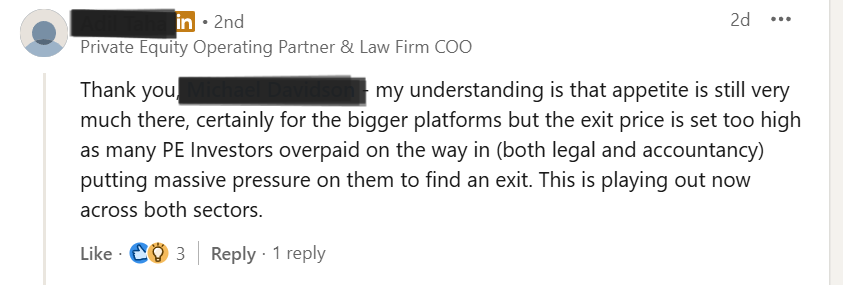
And often, the revenue returns private equity firms hoped for never fully materialised.
Wrapping up…
The accounting space is still attractive.
Firms continue to take in PE capital, not just in the UK and US but globally. (Indian firms, too, are waiting to go the PE way!)
But the valuation expectations are adjusting. The days of sky‑high multiples based on growth narratives alone are fading.
FAQs
What is an accounting firm roll-up?
An accounting firm roll-up is a platform created by acquiring and combining multiple smaller accounting firms under one group, usually backed by private equity.
Why is private equity investing in accounting firms?
Because accounting firms have predictable, recurring revenue, sticky clients, and fragmented markets — making them ideal for consolidation and leverage-driven returns.
Are accounting firm roll-ups overvalued?
Some are. Valuations based on aggressive growth assumptions and high EBITDA multiples are increasingly being questioned by buyers, especially where integration is weak.
What EBITDA multiples do accounting roll-ups typically trade at?
- Traditional firms trade at 4–6x EBITDA.
- Well-structured growth platforms trade at 7–10x EBITDA.
- Valuations above that require strong integration and organic growth.

