 TFS Gulf



- Accenture has invested billions into building AI capabilities and spends about $1 billion a year upskilling employees in AI.
- Problem? Many employees still don’t consistently use their proprietary AI tools.
- As reported by the Financial Times, Accenture has a new policy: “Senior managers and Directors, use AI regularly, or there’s no promotion for you.”
What is happening?
Accenture is tying salary to the use of AI.
The consulting firm is monitoring how frequently senior employees log in to AI platforms each week. This is currently for L6 and above (e.g., senior managers, associate directors and above).
The list of tools (20+) was shared via email. To name a few:
- AI Refinery, which turns raw AI into working business solutions,
- SynOps, Accenture’s human-machine engine is designed to rewire business operations from the ground up.
Going forward, AI engagement is expected to become a factor in performance/salary discussions.
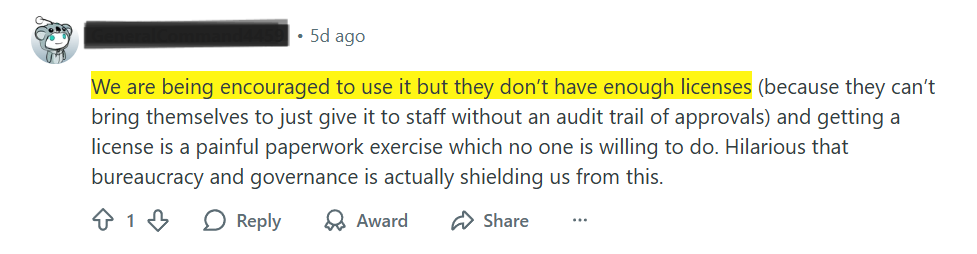
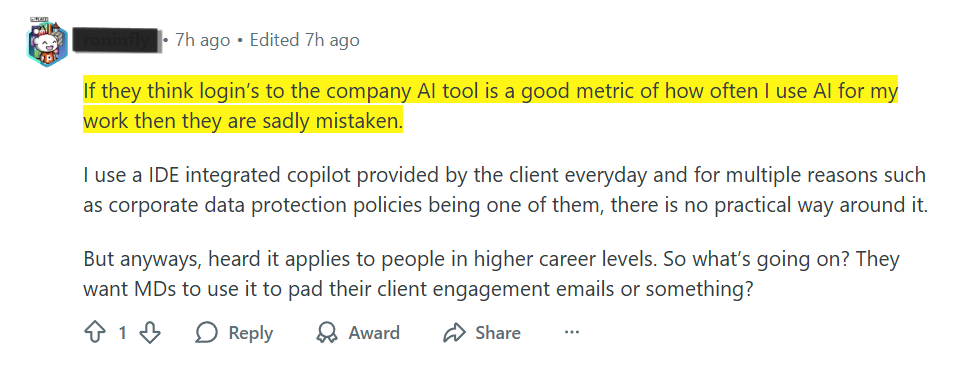
As reported by FT, several staff members claim the tools are cumbersome and ineffective, and some have threatened to quit.
But why is Accenture doing this
Accenture, one of the world’s largest consulting and technology companies, is spending billions on AI to transform consulting and operations.
First off, in 2023, it pledged to invest about $3 billion in AI development, tools, and research, and has trained hundreds of thousands of employees in AI skills.
The outcome? In fiscal 2025 alone:
- Revenue hit $69.67 billion, up 7%.
- New bookings surged to $80.6 billion
- AI revenue is growing rapidly, reaching approximately $2.7 billion in FY2025 (almost triple the previous year).
On Feb 23, 2026, OpenAI signed multiyear partnerships with Accenture, Boston Consulting Group, Capgemini, and McKinsey to deploy enterprise AI platforms and embed AI agents into client operations.
Selling AI transformation to clients around the world is one of Accenture’s most important revenue plays.
So, when Accenture’s own senior consultants resist using the technology, it loses the race in front of its shareholders and clients. Doesn’t it?
The wider industry AI race
Accenture is not alone.
IT majors such as TCS and Wipro are also pushing AI adoption, though with different strategies.
TCS is encouraging consultants to highlight AI-driven efficiencies to clients even when those efficiencies could reduce traditional billing models.
It sounds counterintuitive: why promote technology that might shrink service revenue?
The bet is that productivity gains will expand the market, creating new opportunities rather than destroying existing ones.
Also read: Accenture CEO announces new “Reinvention Services”
Ironically, smaller firms are winning
This is where things get slightly uncomfortable for firms like Accenture and the Big 4.
They have the money, built the tools, and invested billions. But rolling out AI across hundreds of thousands of employees, across dozens of countries, could be painfully slow.
Hywel Ball, former EY UK chair, had previously told the Financial Times, “The Big 4 are lagging behind smaller rivals.”
Ball explained that the bigger you are, the harder it gets to change fast. Smaller firms don’t have that problem.
They can go from “let’s test this tool” to “this is how we work now” almost instantly.
And they’re already winning clients because of it.
Wrapping up…
The motivation behind Accenture’s internal AI monitoring isn’t subtle.
- Over 550,000 employees have already been trained in AI.
- It has signed high-profile partnerships.
AI is no longer optional in consulting.
Hybrid models will define the next era of professional /consulting services.
That is why firms are tying AI adoption to careers, because they believe future competitiveness depends on digital fluency.
Let’s not forget Accenture’s stock is 42% down over the past year!
FAQs:
What’s the new AI-linked promotion policy at Accenture?
Accenture has begun linking some promotions, especially leadership-level ones, to how regularly employees use its AI tools.
The company has told senior managers and associate directors that “regular adoption” of internal AI systems will be a visible factor in promotion decisions.
Does everyone across Accenture need to use AI to be promoted?
No.
- The reported policy applies mainly to senior or leadership-track promotions right now.
- Some groups are explicitly exempt, such as staff in certain European countries and employees working on U.S. federal government contracts.
- There’s no indication yet that Accenture has said every employee at every level must meet a minimum AI usage threshold for all promotions.

