 TFS Gulf



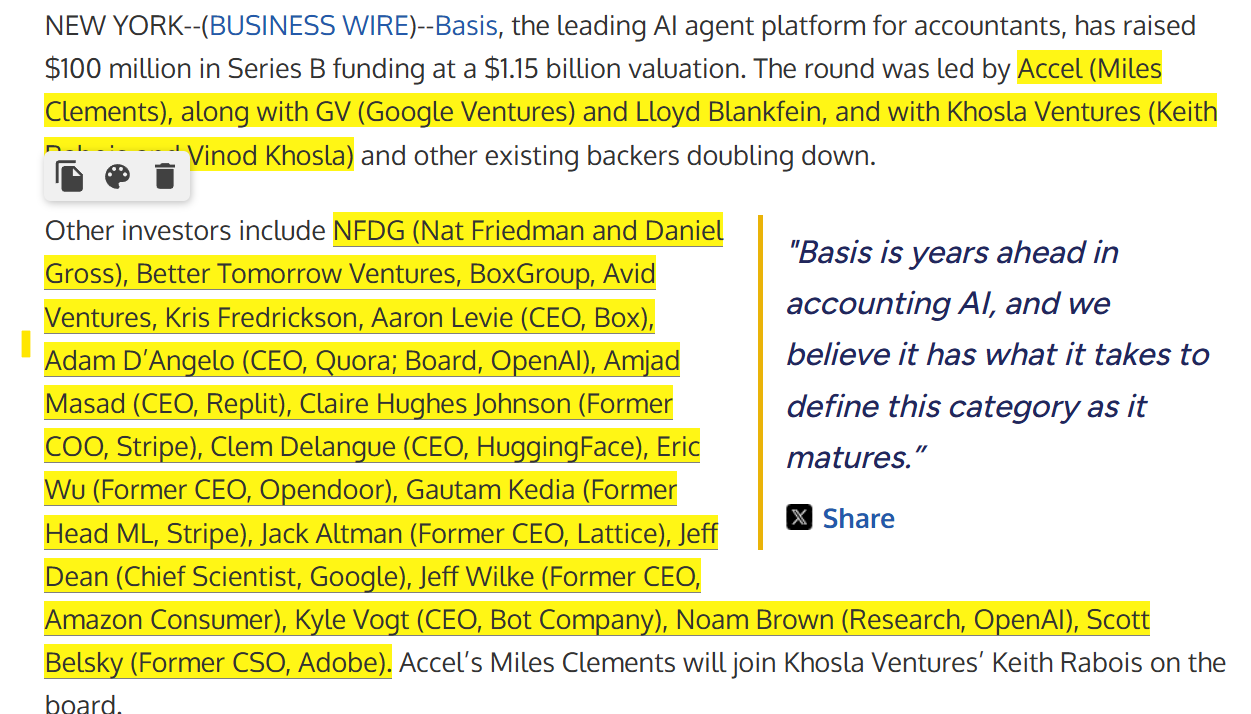
- Basis, the AI accounting startup, just raised $100 million at a $1.15 billion valuation.
- Why the hype? They’re building “AI agents” that can automate financial statements, tax returns, and expense tracking.
- Adoption metrics are staggering…Currently, 30% of the top 25 US accounting firms have integrated Basis into their daily workflows!
The “Agentic” shift
New York-based Basis has officially entered unicorn territory after raising its Series B.
Backed by Accel, GV, and former Goldman Sachs CEO Lloyd Blankfein, the company isn’t selling “automation”…It’s selling digital coworkers, aka Agentic AI.
A source close to the firm’s development team wrote, “The agent understands the ‘why’ behind a reclassification. It reconciles, categorises, and drafts the return….A human simply signs off.”
Meaning the AI doesn’t just answer a prompt; it works for hours on a single, complex return.
These are autonomous entities capable of navigating complex work.
We’ve raised $100m at a $1.15b valuation from @Accel, @GVteam, and existing investors to accelerate deployment of the most capable and accurate accounting agents across CAS, tax, audit, and advisory.
Basis is used by 30% of the Top 25 accounting firms and dozens more across the… pic.twitter.com/r7tympZwZu
— Basis (@trybasis) February 24, 2026
But what triggered Basis’ $1.15 Bn valuation?
In the official funding announcement released on February 24, 2026, Basis explicitly stated:
“The company recently demonstrated the first AI agent to complete an end-to-end 1065 tax return autonomously.”
Okay, so in the accounting world, Form 1065 (U.S. Partnership Tax Return) is one of the most complex and labour-intensive filings in the U.S. tax code.
Traditionally, this takes a human junior (or an offshore team) 10 to 15 hours of manual “grunt work.”
CPA Firms using Basis report up to 30–50% efficiency gains.
Miles Clements, Partner at Accel, mentioned in a press release, “Basis is deploying real agents doing real work in the real economy. They are years ahead in the accounting AI space.”
Accounting AI: Growing ecosystem
The “Accounting AI” boom of early 2026 has created a new class of titans:
Pennylane: The French unicorn recently raised €175 million (valuing it at $4.25 billion) to dominate the European SME market. It’s an AI-powered, all-in-one financial management platform.
Accrual: Launched in February 2026 with $75 million from General Catalyst, specifically targeting the “Preparation and Review” bottleneck in Top 100 firms.
Accrual is building an AI-native accounting platform to transform how accounting firms prepare and review tax returns and related financial work.
Pilot: AI-assisted bookkeeping and CFO services. They Raised $160M+ and are used by thousands of startups
Numeric: Yes, an AI automation for financial close and reconciliations. They have raised $38M+
Digits: AI-powered accounting platform for startups that has raised $97M+. Backed by Google Ventures and Benchmark!
And we are sure a lot more will get funded in 2026.
Also read: Capgemini disrupts outsourcing/BPO industry with AI agents
So, will AI agents replace accountants?
Matt Harpe and Mitchell Troyanovsky frame their AI as a tool to “equip” and “empower” accountants, not to fire them or make them jobless.
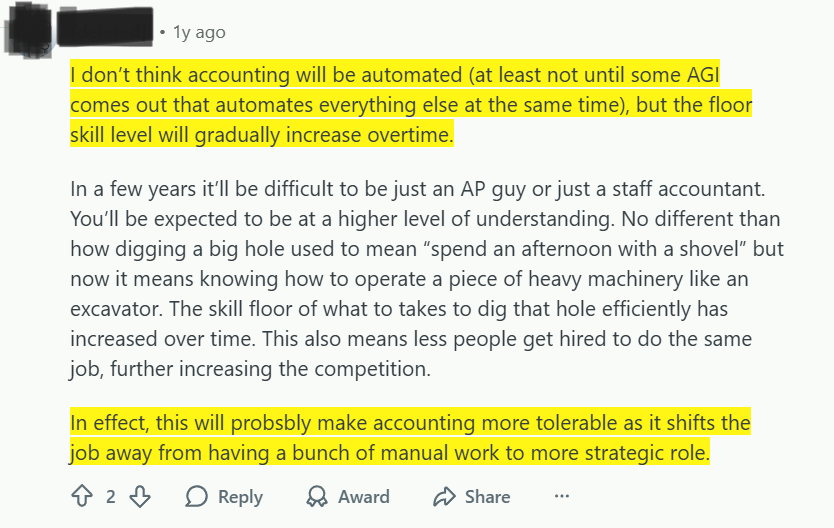
In this new paradigm, a first-year associate at a firm like PwC or EY won’t spend 60 hours a week in Excel.
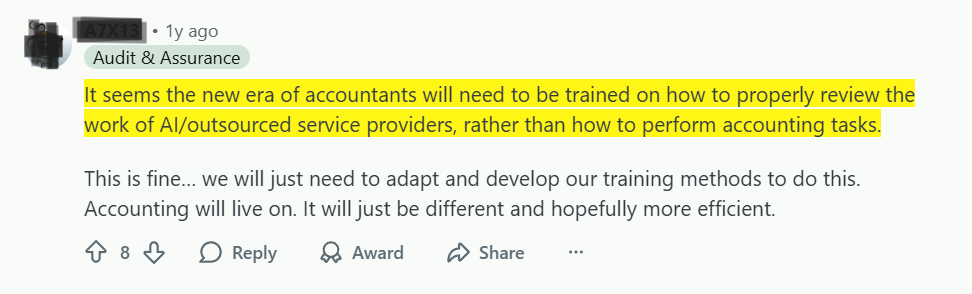
Instead, they will act as an “AI Supervisor”, managing:
- Fleet of agents
- Handling complex “exceptions” that the AI flags
- Pivoting immediately into high-value advisory work
Big question – Will it impact India’s offshore CPA firms?
With private equity accelerating investments in CPA firms, the direction is clear: investors are valuation-driven.
And valuation expansion does not come from “selling hours.” It comes from selling outcomes, scalability, and margin expansion.
Offshoring (still) exists because of cost arbitrage (cheap labour)….Well, AI agents can remove that equation significantly.
One India CPA Firm leader said, “With AI in the picture, calculating productivity or growth by headcount is going to be out the door pretty soon.
Of course, there is going to be an increase in headcount, but the expectations have changed.
If you were doing 10 things last month. This month, you should be able to do 20 things and next month, 30.”
Another CPA Firm India leader told The Finance Story,
“We are rethinking learning and development not as a checkbox, but as preparation for the AI-driven model. Curriculum, roles, and skill paths are being revisited so teams are ready when tools go live.”
Also read: Big 4 struggle with AI adoption, while midsized & boutique firms win
Wrapping up…
According to Basis, 30% of the top 25 accounting firms and 20% of the top 150 firms are already using their AI Agent for day-to-day functions.
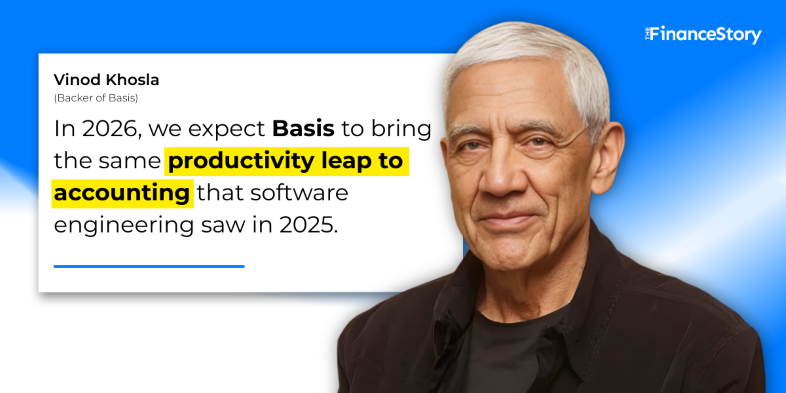
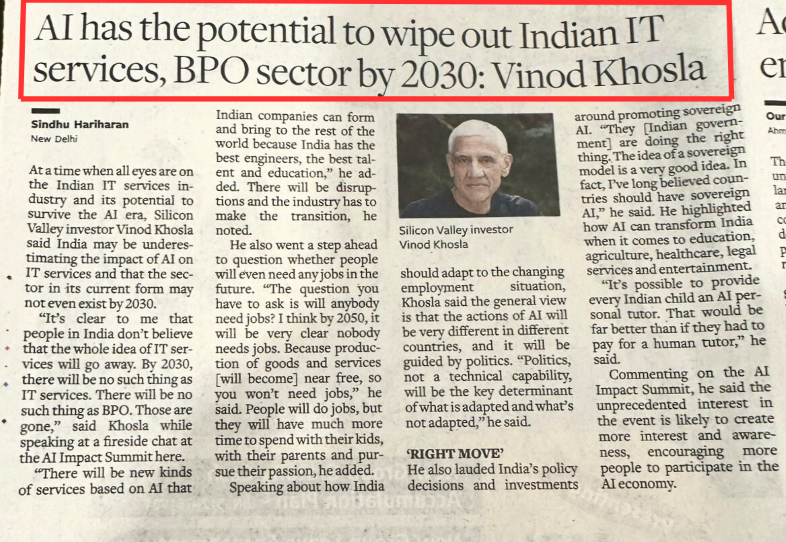
Vinod Khosla (backed Basis) even stated, “In 2026, we expect Basis to bring the same productivity leap to accounting that software engineering saw in 2025.”
FAQs
Q: Why are investors suddenly pouring billions into AI accounting startups?
Accounting is the “perfect use case” for AI because of the following specific factors:
It has massive margins: Moving from “hours billed” to “automated outcomes” allows firms to maintain high fees while slashing labour costs.
Low ambiguity: Accounting is rules-based and data-heavy. Unlike creative fields, accounting has “right and wrong” answers, making it easier for specialised AI models to prove their value quickly.
But the question remains with AI agents…
- What happens to hiring?
- Offshoring?
- Margins?
Q: Can AI really replace junior accountants?
No. Sure, it is replacing or automating all the tedious tasks. But it will not necessarily replace the people. Today’s “junior accountant” is becoming an AI Supervisor. Instead of doing the work, they are responsible for reviewing AI-generated drafts, handling “exceptions” (errors the AI flags), and managing data security.

