 TFS Gulf



- The CFO role is changing faster than anyone expected.
- And if you’re in finance, this affects you directly.
- Oliver Wyman and NYSE surveyed 494 CFOs, representing 12% of the global market cap.
- Here’s what they found.
CFO mandate has changed
Strategy and transformation now rank among the most important responsibilities a CFO holds.
Financial reporting, the thing the role was literally built around, sits near the bottom of the priority list.
And it gets more interesting.
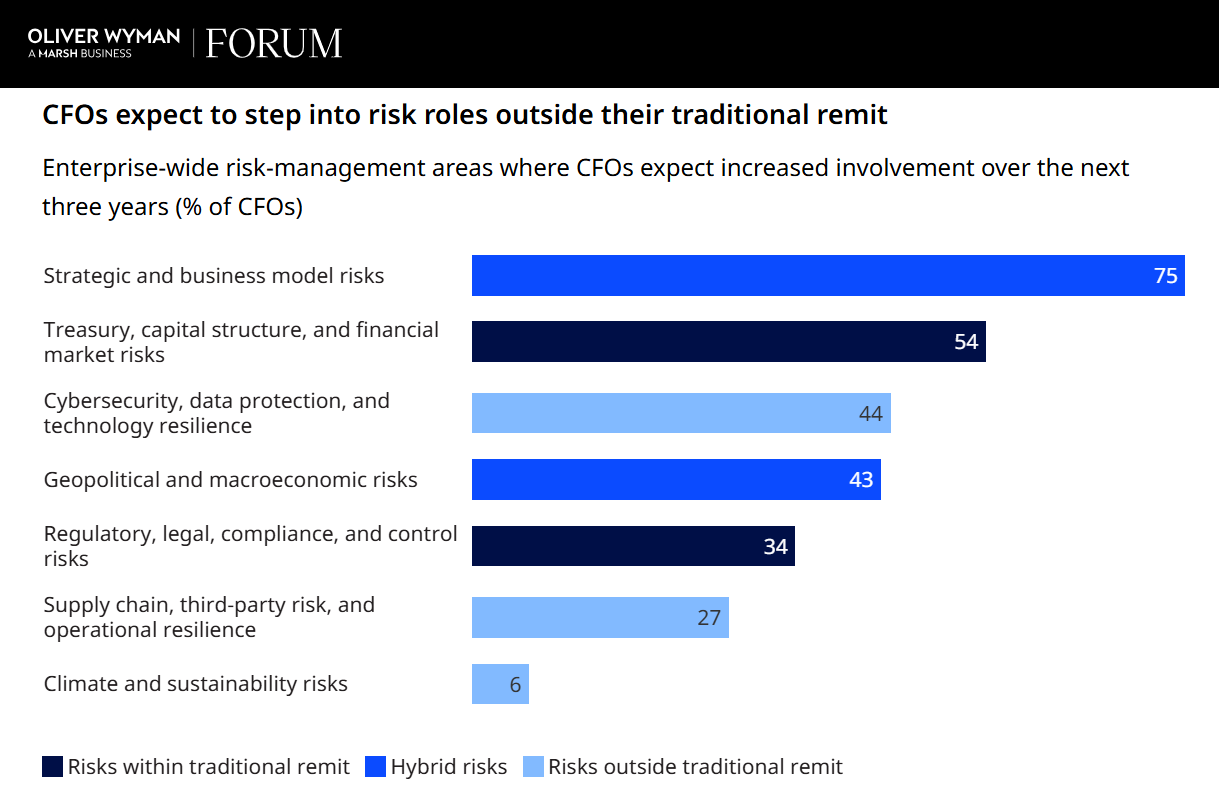
44% of CFOs expect to assume greater responsibility for cybersecurity and technology resilience. That’s the CTO’s job, or at least, it used to be.
And yes, CFOs are becoming the CEO’s right hand.
 CEO pipeline has a new feeder…CFOs!
CFO-to-CEO promotions are red hot…it reached a 10-year high in early 2026.
1 in every 10 new CEO appointments at Fortune 500 and S&P 500 companies came directly from the CFO seat.
Why? Because the skills that make a great CFO: navigating volatility, allocating capital under pressure, driving business model transformation, are exactly the skills boards are desperate for at the top.
The shrinking “Diamond” team
Here’s the uncomfortable truth for anyone early in their finance career.
The finance team is moving from a Pyramid (lots of junior staff doing manual tasks) to a Diamond (fewer juniors, more mid-level strategic analysts).
As the CFO role expands, the finance team is contracting.
- 91% of CFOs expect their finance workforce to hold flat or shrink
- 61% anticipate little change
- 30% expect a reduction of more than 10%
- Only 9% plan to grow meaningfully
- 64% expect to move away from junior roles entirely
The goal is a leaner, “middle-heavy” team focused on high-value advisory work.
Also read: CFOs in UAE are doing it all: Strategy, Tech, ESG, AI
Europe vs Asia: two very different finance playbooks
Not every region is reshaping finance the same way.
Europe is moving in a more controlled, gradual way.
- Less aggressive embedding of finance into business units…stronger preference for central control of finance processes (48% of CFOs are pushing for more centralisation, as with North American companies)
- More emphasis on standardisation + shared services
Asia-Pacific is more experimental:
- 46% of CFOs are embedding finance teams deeper into business units
- At the same time, 56% are increasing shared services and capability centres
CFOs want AI…but don’t fully trust it yet
The hesitation is not about interest. It is about consequences.
In finance, errors are sometimes expensive, sometimes catastrophic.
That is why CFOs are cautious in areas like:
- Cash flow
- Working capital
- Treasury
These are still seen as “no-failure zones.”
But adoption is happening faster in less sensitive areas:
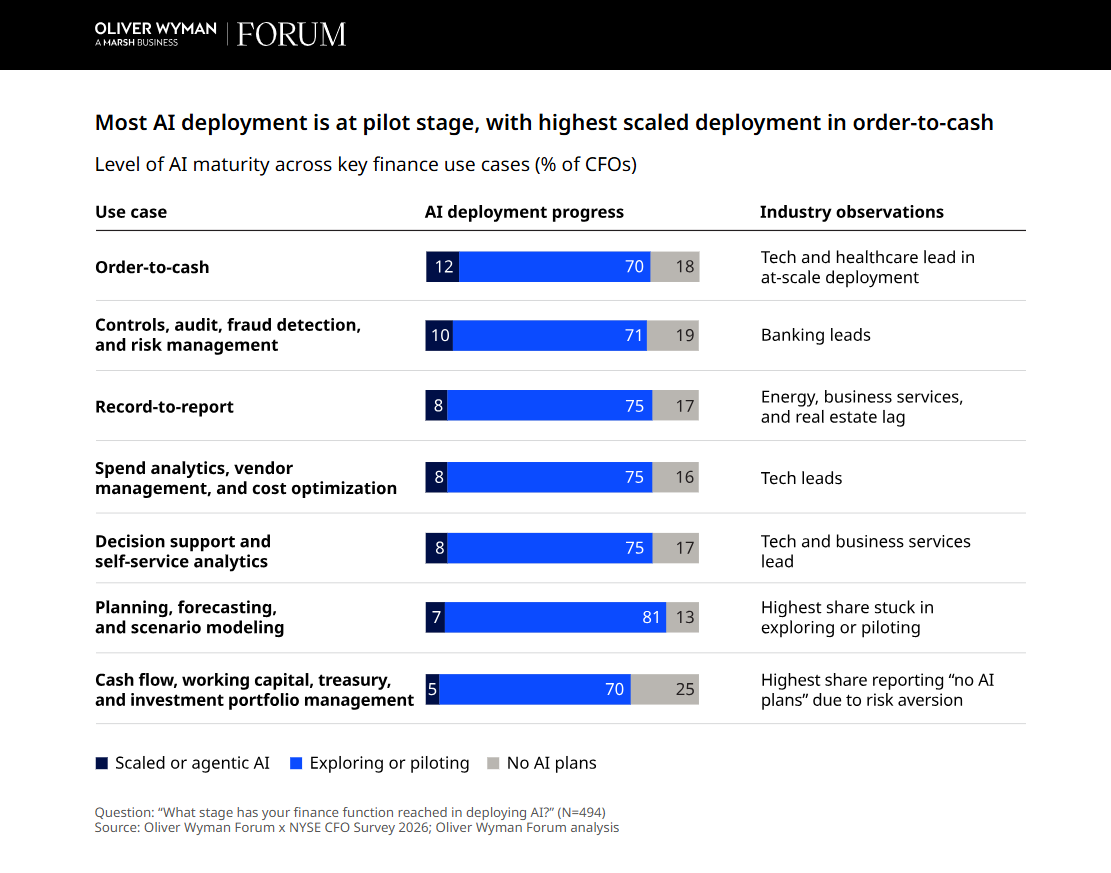
- order-to-cash processes
- audit and fraud detection
- controls and compliance
The pattern is clear: AI is entering finance, but only where the risk is controlled.
AI spending is rising, but execution is lagging
According to the survey, 61% plan to increase AI-related spending by up to 20% in 2026, while another 16% expect even larger increases.
Yet despite the enthusiasm and the money, the actual pace of AI adoption remains surprisingly slow.
- Only 8% of CFOs say they have deployed AI at scale across finance.
- A staggering 74% are still stuck in pilot mode
- 13% – 25% have not even started planning AI deployment across several key finance functions.
Now here is the interesting part.
CFOs who’ve been through failed implementations will tell you the same thing: companies tried to run AI the same way they ran every other transformation.
- Giant multi-year projects.
- Endless integrations.
- Consulting programmes
That takes 2-3 years to go live…well, by then the market has changed.
But when implementing AI, what finance transformation teams really need is:
- Real-time insights
- Faster forecasting
- Instant scenario modelling
- Continuous decision-making
And for that to happen, CFOs and the entire finance team need to collaborate, especially with the CTO.
What are CFOs most worried about?
As the role evolves, some things still keep CFOs up at night.
- Macroeconomic and geopolitical instability. Nearly two-thirds cited them as their biggest worry in 2026.
- Business model disruption follows close behind.
- Then comes AI and digital transformation. (In banking, 40% of CFOs name AI as the single biggest force changing their role. The highest of any sector.)
Also read: Figma’s $100Mn AWS Cloud Bill. Are CFOs paying attention?
Wrapping up…
For all CFOs in India….
The future CFO won’t be the person who simply protects the numbers.
It will be the leader who can allocate capital under pressure, drive transformation across the business, and turn AI ambition into real execution.
The CFOs who figure out how to close the gap between AI ambition and AI execution are the ones being handed the CEO job.

