 TFS Gulf




- India’s audit market is bracing for its biggest shuffle in nearly a decade.
- Over 957 listed companies will go auditor shopping across FY2026–27 and FY2027–28.
- And once again, the “Desi Big 4” question is back…Can Audit Rotation 2.0 finally challenge the dominance of global networks?
First, let’s be honest about 2017
The first major audit rotation cycle (2017–18) was expected to disrupt the market.
In reality, companies replaced one Big 4 firm with another. Decisions were often relationship-driven rather than capability-driven, and the overall structure of the audit market remained intact.
The numbers tell a story.
As of March 31, 2025, affiliates of the Big 6 (Deloitte, PwC, EY, KPMG, Grant Thornton, BDO), audited:
- 326 of 483 Nifty-500 companies
- 694 of 2,069 NSE-listed companies
The Big 4 alone accounted for roughly 29% of total audit fees among NSE-listed companies in FY24–25.
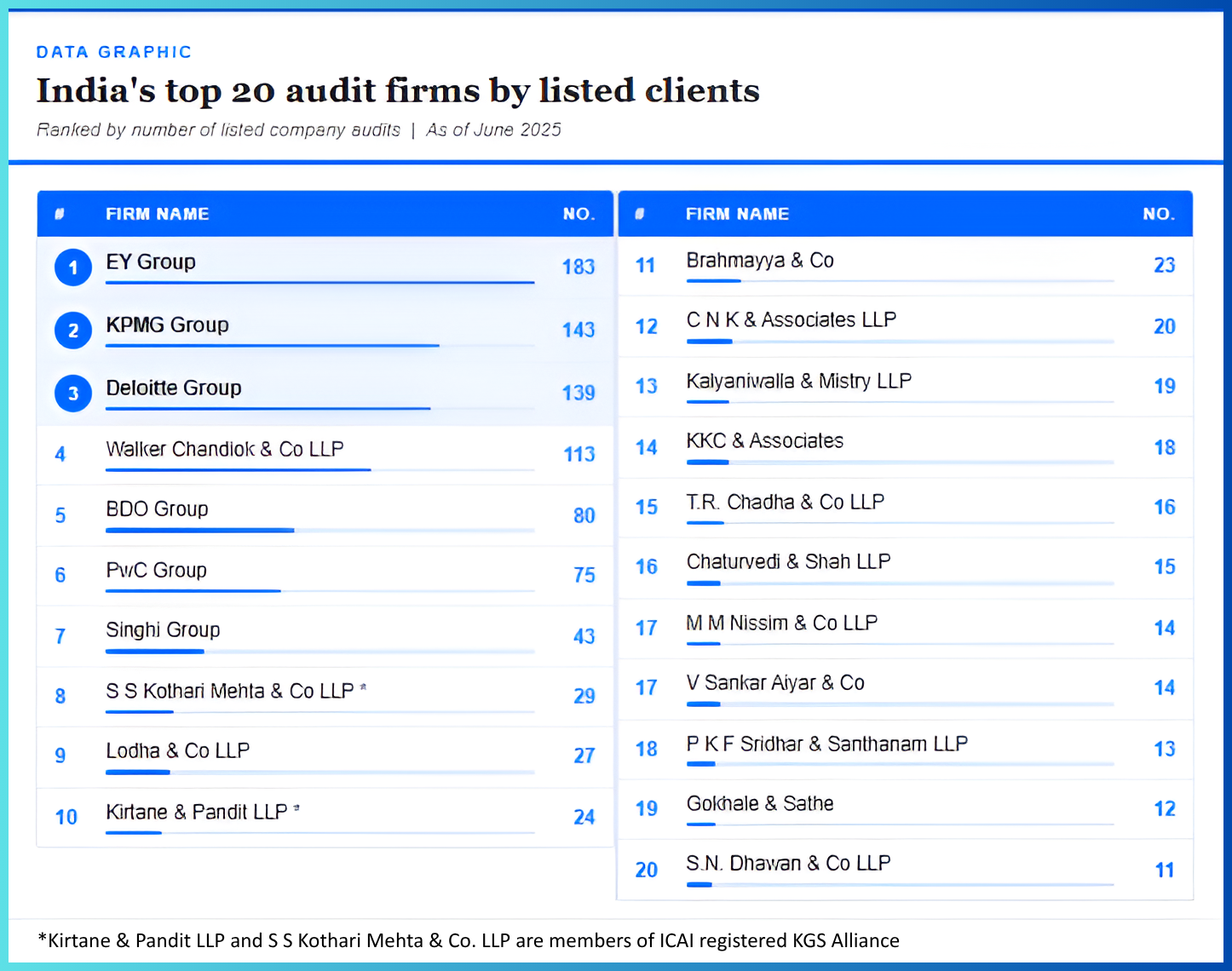
In terms of mandates:
- EY leads
- Followed by KPMG and Deloitte
- Walker Chandiok (Grant Thornton affiliate) ranks 4th
- MSKA (BDO affiliate) ranks 5th
- PwC comes in 6th
That last detail is telling.
As Vikas Kumar, CEO at T R Chadha, notes: “It went from Big 4 to Big 6… the market has started to evolve.”
But what actually changes in Rotation 2.0
The first Audit Rotation did not fully break the market open for Indian firms, but it reshaped it in quieter ways.
Regulator is no longer passive
NFRA, India’s audit watchdog, has transformed itself from a dormant regulator into a genuinely aggressive one.
Between 2022 and 2025 alone:
- It debarred or imposed fines on 103 auditors.
- Issued 23 disciplinary orders in 2024–25, critiquing the audit quality of several prominent listed companies.
According to Akshay Purandare, a Partner at Kirtane & Pandit (Member of KGS Alliance),
“There is a shift firsthand, be it in audit methodologies, procedures, or documentation practices.
And firms across India are updating themselves aggressively to keep up.“
The signal is clear: audit accountability is now real.
Transparency is real
Another notable structural shift:
- Inspection reports are made public
- Audit Quality Maturity Model (AQMM) scores are referenced,
- And firms are increasingly judged on capability, not just brand.
For large Indian CA firms that have invested heavily in quality infrastructure…This creates a tailwind that did not exist during the 2017 audit rotation cycle.
“Big 4 or nothing” mindset has shifted
When the RBI forced banks and NBFCs to rotate, many worked with Indian CA firms for the first time.
As Akshay Purandare, Partner at Kirtane & Pandit, told us: “They gradually realised that appointing other equally capable firms may not be such a bad idea.”
That’s a quiet but important shift in how large companies think.
Add to that Vikas’s notes: “Prime Minister has explicitly spoken about the need for Indian CA firms to grow. That has created a lot of buzz.”
Bidding process has changed, too
Back in 2017, firms typically submitted presentations + pricing…All in one bid.
Today, it’s a two-stage process.
- First, you get evaluated on capability, sector knowledge, Technology stack, audit quality.
- Only after that do they open the commercial bids.
Getting into the room can take 12–18 months. And even then, winning the mandate isn’t guaranteed.
Most interesting story…
Consolidations and Alliances are beginning to appear, and Audit rankings may no longer be about individual firms.
For instance, KGS Alliance:
- Kirtane & Pandit (West),
- SS Kothari Mehta (North),
- Guru & Jana (South)
They’re pooling technology subscriptions, databases, and talent pipelines.
On a combined basis, SS Kothari + Kirtane & Pandit are auditing close to 70+ listed entities.
PwC = 75 listed audits (FY24–25)
On a combined basis, they’re approaching Big 4-level scale in certain segments.
ICAI eased advertising
Some firms are happy about it, while some are not.
A managing partner at a Top 20 firm put it bluntly: “With all due respect… Advertising will only have a negative impact. It’s more likely to increase our costs than our revenues.”
One partner adds a sharper operational concern: “We’d probably have to add ₹2–3 crores in advertising, brand building, sponsorships… just because it’s allowed now.”
And that cost, in his view, does not translate into incremental audit wins.
Audit committees do not choose firms based on visibility campaigns. They choose based on capability, trust, and network strength.
Rise in talent mobility
Akshay told us: There’s a noticeable rise in Partner mobility and lateral hiring
Firms are competing aggressively for:
- Sector expertise
- Listed company experience
This is slowly redistributing capability across the ecosystem.
But CFOs aren’t charmed by narratives
Despite these shifts, the actual decision-making framework at the top of the market remains largely unchanged.
For CFOs and the audit committee, these are not theoretical concerns. They directly influence risk, investor confidence, and regulatory exposure.
- Can a firm handle multi-geography consolidation within tight reporting timelines?
- Can it match the audit infrastructure and data capabilities of global networks?
- Can it provide technical depth on complex accounting issues without escalation gaps?
As one Big 4 Audit partner explains:
“Most large corporations don’t operate in a single geography. The question isn’t just capability, it’s whether firms can sign off across jurisdictions and manage that complexity in time.“
And on these parameters, global firms still hold an advantage. Technology is a clear example.
Indian firms are investing heavily, but the gap, while narrowing, is still visible.
Even AI is increasingly entering boardroom discussions.
Vikas mentions, “It’s actually Boards, not CFOs asking about AI now.”
Boards want to know whether our firm is using AI and whether we can provide a higher level of assurance beyond the traditional ‘true and fair view’ required by law.”
But as Akshay Purandare cautions, “AI in audit is still at a primitive stage.”
Also read: Audit rotation 2026-27: 957 companies set to rotate. Can Big 6 maintain their dominance
One silent issue
Fee undercutting.
For years, mid-sized firms accepted mandates at unsustainable rates to get in the door. That mindset is beginning to shift.
Firms are walking away from mandates where the fee doesn’t justify the regulatory exposure.
As Vikas puts it, without softening: “If you pay peanuts, you’ll only get monkeys.”
The irony is that the Big 4 have their own version of the same problem.
As one Big 4 partner summarised it: “If one Big firm quotes $100 and another quotes $90, the client will just move…Both are trusted names, so price becomes the decider.”
Also read: Auditors big challenge – Rising costs of talent, tech but stagnant audit fees
So, who wins Audit rotation 2.0?
Audit is still a brand market….The Big 4 and broader Big 6 are expected to retain dominance.
Estimates suggest that just about 10% of mandates may move outside this Big 4/6 ecosystem.
Good quality companies will upgrade to the Big 4. Firms outside that circle will move between the next 3–4 firms, the top Indian firms.
The real winners:
- A small set of strong Indian firms (Those positioned for listed Audits and invested in Tech, Talent and quality research)
- Mid-sized firms will absorb incremental mandates
- Smaller firms will face increasing pressure as expectations around capability, compliance, and technology rise.
Yes, Indian audit firms today are stronger than a decade ago…Better capitalised, better staffed, and more networked.
But they have not automatically translated into a “Desi Big 4” outcome…For real change, regulations crippling the Indian firms will have to be fixed.
FAQs
Will audit rotation help Indian CA firms grow?
While audit rotation creates opportunities for mid-sized and Indian CA firms, historical trends show that most large mandates continue to stay within Big 4 and Big 6 networks.
Who are the Big 4 and Big 6 audit firms in India?
The Big 4 include Deloitte, PwC, EY, and KPMG. The broader Big 6 also includes Grant Thornton and BDO, which together dominate a large share of listed company audits.
How much of India’s audit market do Big 4 firms control?
Big 4 firms continue to account for a significant portion of listed company audits in India, particularly among large-cap and Nifty 500 companies.


One of the biggest constraints audit firms face in taking on new mandates is internal, auditor independence. Regulations governing non-audit services to audit clients and their related entities are stringent and often restrictive.
This creates ongoing tension between audit and consulting teams over client selection, which relationships must remain purely attest, and which can support advisory work. The stakes are high. Consulting engagements typically span multiple years, generate significantly higher fees than audits, and deliver stronger margins, so these decisions directly affect firm revenue and partner profitability.
Nor is the choice straightforward. Firms can’t simply walk away from audits. Clients often dictate auditor and advisor appointments, and may require firms to participate in competitive bids for both roles, further complicating independence considerations.